
|
|
 |
|

| Issue 34: | Sept. 2026 |
| Essay: | 1,304 words |
| Footnotes: | 456 words |
Essay and Visual Artworks
by Kendall Johnson
Writing for Light, Part 6
The Poetics of Light
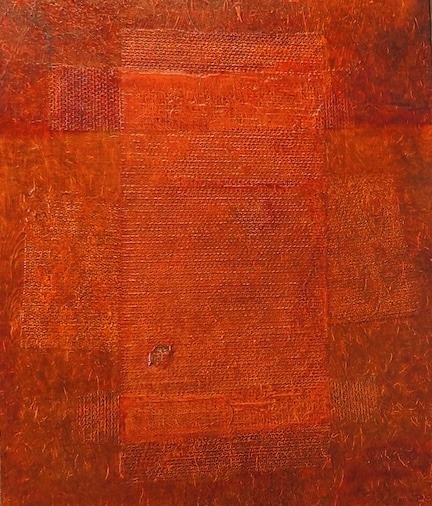
If I Just Look Harder (2025) © by Kendall Johnson1
“Give me some light! Away!”
In Shakespeare’s Hamlet, Claudius is exposed as a murderer when he suddenly rushes out of a darkened theater overwhelmed with guilt triggered by a clever reenactment of his own secret crime.2 The darkness in the theater had itself had become smothering. Claudius sought light to breathe. We all seek light.
In the dark days of Christmas 1939, Albert Frederick Arthur George (“Bertie” to his family), thrust into the unanticipated position of King of England by the abdication of his brother, spoke these words in a message to a fearful nation anticipating the worst and needing much:
“Give me a light that I may tread safely into the unknown.”
Words that helped galvanize a nation’s resolve. Actually written by a poet and teacher, Minnie Louise Haskins,3 whose poem was handed to the King by his 13-year-old daughter, Elizabeth. King George VI quoted the poem in his Christmas radio message, enheartening his people, less to battle, more to endure.4 A poet helped give the English people the courage they would need to survive the coming Battle of Britain against Hitler’s gathering Luftwaffe and rockets.
Next to oxygen and food, we all need hope during our darkest times, and the times we live in now are turning dark indeed. Fancy cars and lavish spending cannot long protect us against environmental shift and domestic fracture. We need hope in a possible future, reason to persist and to hold on. We as creative people, the writers and artists among us, already have the tools to help do that best. It is our choice to broadcast through our work hope rather than despair.
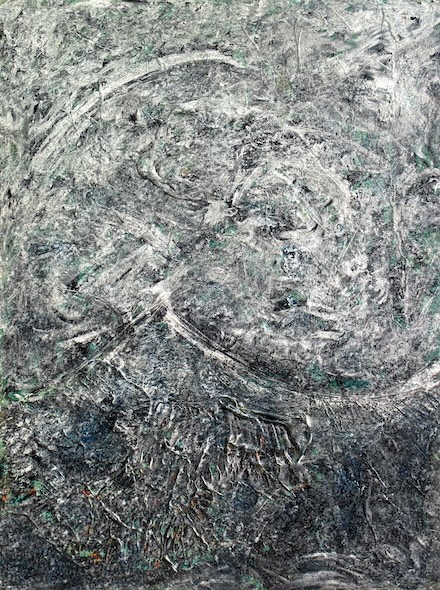
Sea Change (2018) © by Kendall Johnson5
Keeping the Light On
Novelty is attractive. Spectacle, surprise, and technical fireworks are inviting avenues to add to a professional profile. They can also add to the clamor and darkness of the world—or alternatively, to its light. As a creator approaching a project, how you approach what you do matters. Preparing a writing project or an art exhibit, I’ve found the following considerations helpful:
- Exercise due diligence: spend time on the ground. Research what you are writing about, including context and background as well as others’ writing about it. Try not to add to the clouds of mis- or disinformation.
- Whether you are interviewing, doing an impressionistic description, or writing opinion, talk to those involved. Find out their intent, purpose, concerns, and approaches. How might they be affected by what you do or say?
- Consider your own personal investment in the situation, including its context and how it affects you. Transparency isn’t just about what you tell others.
- Think about what calls to you about the project. Are you moved by it, do you have a sense of its importance? What possibilities could it open?
- Look to your tools. Consider your capabilities, strengths, limitations, and needs as a writer or artist. How might these best be used? How might you otherwise approach it?
- How can your readers’ and viewers’ appreciation of the moment best be served, and how can you best facilitate that? What is at stake beyond?
I have learned to ask myself the hard one: How can what I am about to do, now, best add to the light of the world?
Yet, in the face of bleak situations such as we are all facing now, how do we know that our skills as writers and artists will have any effect at all? Lest we feel that we lack sufficient tools to resist the forces of darkness around us, consider the impact of a single artist who, from a marketing perspective, was an inconsequential failure. He sold only a few paintings during his lifetime. Often lacking money to buy new canvases, he painted over dozens of his existing canvases. But his work—now known by all—continues to enlighten. His name: Vincent van Gogh.
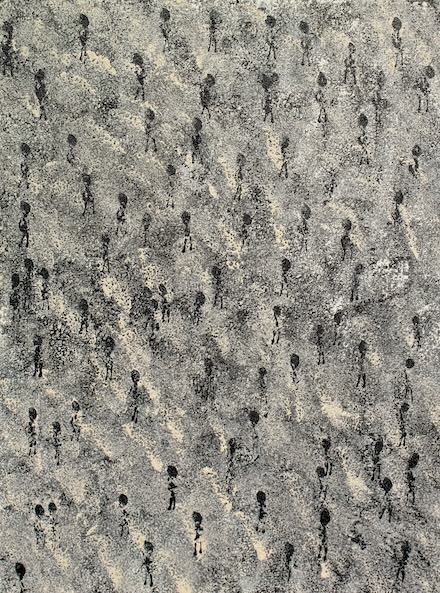
Lost Souls (2018) © by Kendall Johnson6
Consider Van Gogh
Sometimes we look upon Vincent’s time, the latter decades of the 19th century, as calm and on its way to better things. It’s easy to forget that his predecessor Johannes Vermeer painted timeless soul scenes as riots raged outside his studio walls. Edvard Munch anguished about the alienation caused by industrialization. Like Munch, Van Gogh was prophetic, about his times and our own.
The world was gathering for convulsive change during his brief time on earth. The beginning of the bloody twentieth century and with it the end of small-town and rural community. The crushing anonymity brought on—and reaching its peak only now—by the industrial devolution was separating people from each other and from themselves.
Van Gogh himself reminds us, in a letter written in 1889:
We hardly know life, we know so little of its foundation, and besides, we are living in a period in which everything seems to be in a tottering state... In the days we are living through, one runs the risk of returning from a battle ashamed of having fought a battle.7
I’ve traveled three separate times to Europe to view Van Gogh’s work and walk in his footsteps, because I find that his work inspires me. Yet only thirty miles from my home in Southern California the Norton Simon Museum in Pasadena holds my favorite. A beautiful painting, of course, but far more than that. In a catalog for a virtual exhibition, I wrote this about a single painting, The Mulberry Tree (1889)8:
Here Van Gogh completes an extraordinary painting of an ordinary tree, its inner dynamism reflected by its surrounding space. Color builds on texture, composition focuses attention, complementaries vibrate. Vincent’s neurons drive his brush strokes, which in turn enliven our neurons. This tree is nothing short of a miracle. We walk into the garden expecting a simple tree, but are confronted instead by God.9
Then, in a personal letter to the artist despite his being long absent, I wrote:
Your landscapes trade restraint for wild abandon, for rapture. They enchant. ... Vincent, you are Charon the boatman carrying us away from a world premised upon blindness and preconception. Through your work we see our world differently. The river Styx is what we believe to be the end, but you show us that it is only the dawn. Your paintings usher us into our tomorrow.
Fall landscape canticle,
mountains flux and flow.
Sun spun gold, stars wheeling,
trees twist and entwine—
a mad, holy love song.10
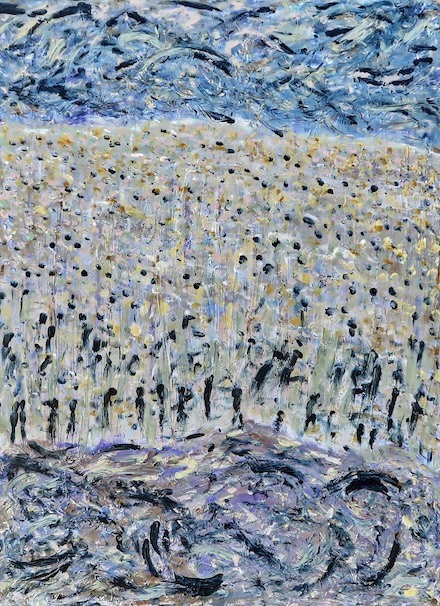
We Are All After Vincent’s Light (2024) © by Kendall Johnson11
The Importance of Our Work
Now, when I put my artwork and my writing out into the world, I must remind myself of the effect Van Gogh’s work has had on me and many others. I’ve learned that, despite my feelings that my work is flawed, inadequate, and falls short, despite how puny it seems in the face of our shared challenges, my work may affect some others more than I anticipate, bring to some a stronger vision, encouragement, and even hope, as Van Gogh’s work has brought me.
In rejecting his preacher father’s ideal of living only for some far away, other world, his artworks and writings still open our minds to a better present, one hidden behind the scales that blind our eyes, a place where flowers and fields sing hymns from within. This is a transcendence brought not by escape, but by sustained presence. He’s described and painted a place where this earth dances through the heavens, whirling in step with its sister starry spheres. He’s shown how celestial light illumines our darkness, and that we live our days in a cosmic embrace. Vincent didn’t create an alternate world, he just points us toward home.
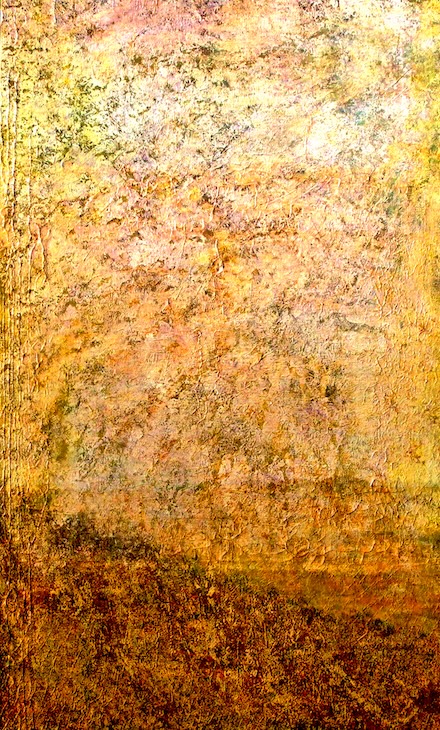
Ridgeline Light (2017-2024) © by Kendall Johnson12
Footnotes:
Links were confirmed on 18 September 2026.
- Kendall Johnson. If I Just Look Harder (2025), mixed media on canvas (detail). From the exhibition Melting into Air: Desert Words and Images at Sasse Museum in early 2025. (Note: This painting does not appear in the Exhibition Catalog.)
- William Shakespeare. The Tragedy of Hamlet, Prince of Denmark, Act 3, Scene 2, Line 2156: spoken by King Claudius, “Give me some light! Away!” Full text available at:
https://www.opensourceshakespeare.org/views/plays/play_view.php?WorkID=hamlet&Scope=entire&pleasewait=1&msg=pl#a3,s2 - Minnie Louise Haskins (1875-1957) was a British poet and academic sociologist who taught at London School of Economics from 1919-1931. The five lines about the gate of the year were the preamble to her poem “God Knows” (popularly known as “The Gate of the Year”), written in 1908 and published in her book The Desert in 1912. For a brief but interesting discussion of the poet and her work, see:
https://blogs.lse.ac.uk/lsehistory/2013/12/10/the-gate-of-the-year-minnie-louise-haskins-1875-1957/ - Recordings of King George VI’s Christmas Message of 1939 are available on YouTube. The written transcript of his nine-minute speech, concluding with his reading of Haskins’s five-line preamble, is available at Wikisource:
https://en.wikisource.org/wiki/Christmas_Message,_1939 - Kendall Johnson. Sea Change (2018), acrylic on canvas. A detail of this painting first appeared in A Whole Lot’a Shakin’: Reconsidering Midcentury (Cholla Needles Press, 2018).
- Johnson. Lost Souls (2018), acrylic on canvas. A detail of this painting first appeared in A Whole Lot’a Shakin’: Reconsidering Midcentury (Cholla Needles Press, 2018).
- Johnson. Adapted from a letter written by Vincent van Gogh to his sister, Willemien van Gogh, on 2 July 1889. For the full text, see Letter #785 at Vincent van Gogh: The Letters (a collaboration between the Van Gogh Museum and the Huygens Instituut, both in Amsterdam):
https://vangoghletters.org/vg/letters/let785/letter.html - The Mulberry Tree (oil on canvas, 1889) by Vincent van Gogh (1853-1890) is on view at The Norton Simon Museum in Pasadena, California:
https://www.nortonsimon.org/art/detail/M.1976.09.P - Kendall Johnson. From his epistle related to The Mulberry Tree painting, in Dear Vincent: A Psychologist Turned Artist Writes Back to Van Gogh (Sasse Museum of Art, e-book, 2020), pages 67-68 (or pp. 70-71 in the Publitas viewer online):
https://view.publitas.com/inland-empire-museum-of-art/dear-vincent/page/70-71
Johnson’s description of The Mulberry Tree also appears in his essay “Fields of Vision” in MacQueen’s Quinterly (Issue 26, January 2025). - Johnson. Ibid.
- Johnson. We Are All After Vincent’s Light (2025), acrylic on canvas.
- Johnson. Ridgeline Light (2017-2024), composite photograph with acrylic on canvas painting.
Publisher’s Notes:
-
Part 5 of this Writing for Light series by Dr. Kendall Johnson is published in Issue 33 of MacQueen’s Quinterly (aka MacQ): The Glare of the Modern, which includes six of Johnson’s mixed-media paintings.
Part 4 appears in Issue 32 of MacQ: Returning to Listen, with seven of Johnson’s artworks.
Part 3 is published in Issue 31 of MacQ: Writing Fire, with five mixed-media paintings by Johnson.
Part 2 also appears in Issue 31 of MacQ: Finding Hope in Darkness, which includes artworks by Kendall Johnson, a sculpture by David Kimball Anderson, and a painting by Dr. Wesley Hurd.
Part 1 appears in Issue 30X (December 2025) of MacQ: Writing in the Dark, with five sepia photographs by Johnson. - The seven essays of Johnson’s series Writing for Vision are published in MacQueen’s Quinterly online (Issues 23 thru 27), as well as in a printed collection released by MacQ in August 2025. The book also includes 24 of his visual artworks in full color and an introduction by essayist and poet Kate Flannery, as described in Issue 29 of MacQ:
Writing for Vision: Voicing the New Wild - The six essays of Johnson’s Writing to Heal series are published in MacQueen’s Quinterly online (Issues 16-19, 20X, and 22), as well as in a printed collection released by MacQ in May 2024. The book also includes a few of his poems and 21 of his artworks in full color, as described in Issue 23:
Writing to Heal: Self-Care for Creators
Kendall Johnson
grew up in the lemon groves in Southern California, raised by assorted coyotes and bobcats. A former firefighter with military experience, he served as traumatic stress therapist and crisis consultant—often in the field. A nationally certified teacher, he taught art and writing, served as a gallery director, and still serves on the board of the Sasse Museum of Art, for whom he authored the museum books Fragments: An Archeology of Memory (2017), an attempt to use art and writing to retrieve lost memories of combat; and Dear Vincent: A Psychologist Turned Artist Writes Back to Van Gogh (2020), which is also available in print. He holds national board certification as an art teacher for adolescents to young adults.
Dr. Johnson retired from teaching and clinical work a few years ago to pursue painting, photography, and writing full time. In that capacity he has written a book on art history and seven books of visual art, poetry, and/or essays, including most recently Writing for Vision: Voicing the New Wild (MacQ, August 2025); and Prayers for Morning: Twenty Quartets, a collaboration with poets Kate Flannery and John Brantingham released on Christmas Day, 2024 by MacQ.
MacQ also published Dr. Johnson’s hybrid collection of essays, memoir, poetry, and visual art: Writing to Heal: Self-Care for Creators (May 2024), which was named a category finalist in 2025 for the Eric Hoffer Book Award. His memoir collection Chaos & Ash was released from Pelekinesis in 2020, his Black Box Poetics from Bamboo Dart Press in 2021, and his The Stardust Mirage from Cholla Needles Press in 2022.
His Fireflies series is published by Arroyo Seco Press: Fireflies Against Darkness (2021), More Fireflies (2022), The Fireflies Around Us (2023), Fireflies for These New Dark Ages (30 November 2025), and Fireflies in America: Songs for Our Dark Passage (forthcoming in Autumn 2026).
His shorter work has appeared in Chiron Review, Cultural Weekly, Literary Hub, MacQueen’s Quinterly, Quarks Ediciones Digitales, and Shark Reef; and was translated into Chinese by Poetry Hall: A Chinese and English Bi-Lingual Journal. Johnson served four years as a contributing editor for the Journal of Radical Wonder.
More on the Web: By, About, and Beyond
⚡ Dark News I-III (a trio of Fireflies from the fourth book of the series, Fireflies for These New Dark Ages) by Kendall Johnson in Issue 30 of MacQueen’s Quinterly (September 2025)
⚡ Dark News IV-VI (a second trio of Fireflies) by Johnson in MacQueen’s Quinterly (Issue 30X, December 2025)
⚡ Seeing Beyond the Clamorous Now, an essay and paintings by Johnson in Issue 25 of MacQueen’s Quinterly (September 2024); nominated by MacQ for the Pushcart Prize
⚡ Through a Curatorial Eye: The Apocalypse This Time, an essay and paintings by Johnson in Issue 19 of MacQueen’s Quinterly (August 2023); nominated by MacQ for the Pushcart Prize
⚡ Kendall Johnson’s Black Box Poetics is out today on Bamboo Dart Press, an interview by Dennis Callaci in Shrimper Records blog (10 June 2021)
⚡ Self Portraits: A Review of Kendall Johnson’s Dear Vincent, by Trevor Losh-Johnson in The Ekphrastic Review (6 March 2020)
⚡ On the Ground Fighting a New American Wildfire at Literary Hub (12 August 2020), a selection from Kendall Johnson’s memoir collection Chaos & Ash (Pelekinesis, 2020)
⚡ A review of Chaos & Ash by John Brantingham in Tears in the Fence (2 January 2021)
| Copyright © 2019-2026 by MacQueen’s Quinterly and by those whose works appear here. | |
| Logo and website designed and built by Clare MacQueen; copyrighted © 2019-2026. | |
|
Data collection, storage, assimilation, or interpretation of this publication, in whole or in part, for the purpose of AI training are expressly forbidden, no exceptions. |
At MacQ, we take your privacy seriously. We do not collect, sell, rent, or exchange your name and email address, or any other information about you, to third parties for marketing purposes. When you contact us, we will use your name and email address only in order to respond to your questions, comments, etc.