
|
|
 |
|

| Issue 30X: | Dec. 2025 |
| Essay: | 2,504 words |
| + Footnotes: | 871 words |
Essay and Visual Artworks
by Kendall Johnson
Writing for Light, Part 1
Writing in the Dark
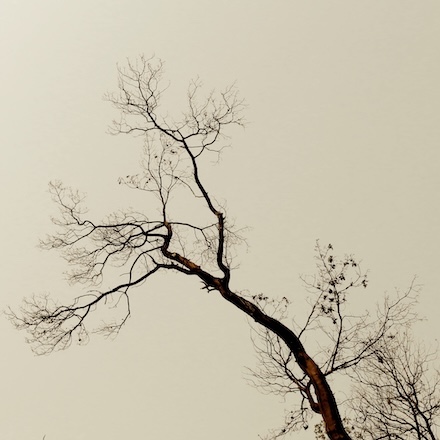
Reach (2025) copyrighted © by Kendall Johnson1
1959: Claremont, California
When I was in seventh grade, the L.A. smog so blanketed the area near my home that the San Gabriel range that rose steeply a mile from our house couldn’t be seen for weeks. The mountains would suddenly appear from the haze, gargantuan, emerging upwards from the brownish-gray brush land.
Three years later I was on the varsity cross-country team, pushing myself hard to work out in the afternoon heat after school, running through the disappearing citrus groves, over freeway construction, and up into the foothills. Our eyes stung and our lungs convulsed. After practice most of us puked, dizzy from the thick air, and drawing pained breath. Every few weeks the winds from the desert blew the smog out, the mountains returned, and at night we could see stars.
Those were the same winds that blew wildfires out of control, conflagrations that would shape my future, and indeed all life in the western states.2
This Fragile World
I remember reading in 1966 about a six-day siege of toxic smog in New York City that killed 265 people. In 1969, we read about a river in Pennsylvania so polluted, it caught fire and burned for several days. The same year a massive oil leak under derricks off the Santa Barbara coast blew over four million gallons of crude oil onto the beaches for eleven days.
Seventy years of slow-won, anti-pollution laws have done much to clear the air in L.A.3 Yet we are now going backwards, with conservatives fighting to bring back coal and oil profits, claim public lands for construction projects, block alternative energy production, and return to the bad old days to line their pockets even deeper. Our collective memory seems as selective as it is short.
Why the retreat? Why go back to darkened skies and toxic waters? How could the success of environmental legislation and preponderance of scientific data warning that it hasn’t been enough, now be ignored? The fledgling science of ecology seems stymied, discredited, and now defunded.
Even the most ardent advocates of climate action question the scope of current thinking. For the past several decades the ecological thinking of the latter part of the 20th century has been superseded by a new “Dark Ecology.” Basically, Dark Ecologists feel that the eco-thinking and earth-first actions up until now have been too little and too late. Cataclysmic climate change is upon us now, and things are already changing badly.
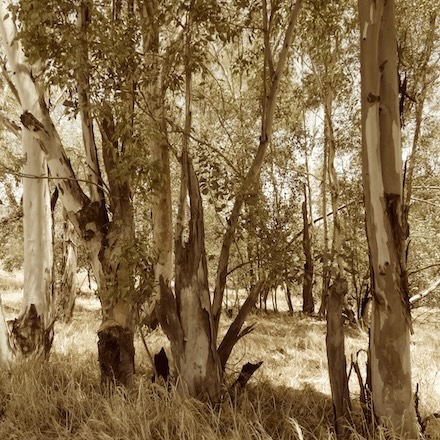
Eucalyptus (2025) copyrighted © by Kendall Johnson4
Holding Tight to Paradise
Amidst the errors there shone forth men of genius; no less keen were their eyes, although they were surrounded by darkness and dense gloom.
—Petrarch (1330s)5
Labeling the time period following the fall of Rome the “Dark Ages,”6 this quotation by Renaissance historian Francis Petrarch opens the conversation about long-range consequences of reacting to an existential threat with radical denial and cultural retraction. The conversation has lasted hundreds of years, punctuated by the rise and fall of whole civilizations, and gains relevancy today.
The natural world may be shifting, rapidly and in a way that may not be conducive to the human world we know, but the point of light remains that the future, albeit clearly uncertain, always remains open. Ask anyone who has spent time in Las Vegas or at horse races. The question is, are we—given the current political deconstruction, book burnings, and attempts to erase history—heading into a new Dark Age?
Traditional compasses failing, we are losing our way and entering a world quickly becoming far darker than the one we were given. Much of our culture is imbedded in the stories from which the culture has already evolved, suited for an earlier era with different circumstances. Those cultural myths and fantasies about the world guided us in directions which are now untenable. We must ask: what stories are now destroying us—irrespective of how comfortable they feel—and what stories are capable of sustaining us? And specifically, as writers and creatives, do we wield important tools to turn this around?
We must ask ourselves, can our work assist in the rebalancing of the world, and help return us all to a place where we belong? As artists and writers, we may sing into a world of lost light, but we still have the power of song.
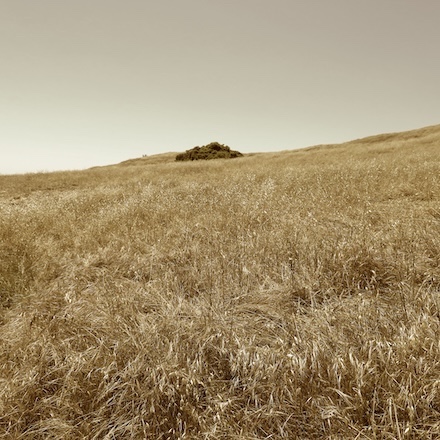
Hillside (2025) copyrighted © by Kendall Johnson7
A Dark Ecology
Conversations with artist and critic Christopher Volpe8 led me to the emerging literature on Dark Ecology and Dark Beauty. I’m brought back to my philosophy studies in the 1970s when British analytical approaches reigned, and aesthetics were argued to be logically inaccessible. The work of Norwegian philosopher Arne Naess shows what I missed because of timing: language and logical analysis proved less than helpful in dealing with larger issues; both scientific and aesthetic experience too important to be limited to language study, ordinary or ideal. He opens grounds for hope against arbitrary limitation.9
Eco-philosopher Timothy Morton elaborates that our understanding of nature is compromised by our anthropocentric bias. We have a short-sighted and self-centered view that hamstrings our capacity to deal with climate change. The traditional environmentalist focus on conservation and sustainability is not sufficient to address the current ecological crisis.
We exist beyond ourselves, Morton points out, a part of a vast matrix of interconnections, a germinal context co-generating our future and that of all beings. His use of the word “Dark” refers to the deep uncertainties of our existence.10
Much of our circumstance is beyond both our understanding and our capacity to control. Our choices result from factors beyond our grasp; the effects of our actions extend beyond our predictions. And the ways we understand the world and frame problems are complicit in contributing to our current situation. Our lives carry the karmic burden of our limited perception. If we are to survive, we need to find a new, cooperative, and collaborative understanding of relationship with natural entities. Dark Ecology offers a healthy, positive reconstruction of our thinking and actions that encourages us to reconnect with living things on earth. It is becoming increasingly obvious that:
- All living beings interconnect and are interdependent.
- There is much we do not know about this web of interdependent connection.
- We must cultivate symbiotic rather than exploitive relationships with all entities on earth, human and non-human.
- We must take responsibility for our impact on the earth and develop an ethic of values and actions in keeping with interconnection.
We are causally entangled, enmeshed with all beings, human and nonhuman. Matter and energy exchange information with the things of the earth forming a living linkage globally. The complexity and interconnection of things are riddled with uncertainties, complicating the making of predictions and estimations of the long-range consequences of human actions.
Acknowledging this will keep us cautious about accepting simplistic linear cause/effect relations or solutions for complex problems. To even begin to address issues like the emerging rapid climate shift, we must adopt a more humble stance toward assessing effects of all of our decisions. An ethic based upon collaboration and ongoing engagement with non-human and human entities alike can build resilience into ecosystems.
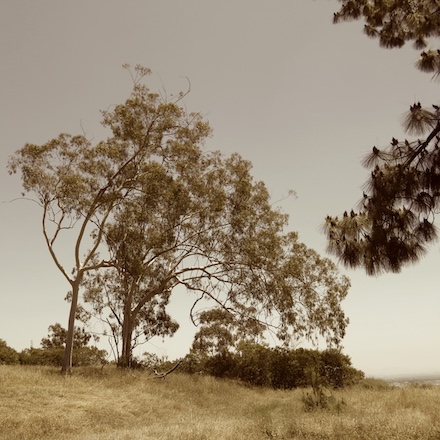
Looking East (2025) copyrighted © by Kendall Johnson11
Darkness and Beauty
Dark Ecology raises the question of meaning, purpose, and practice for those of us feeling the need to do something effective when the future appears so bleak. For those who are creative as well as concerned, a focus upon beauty may reveal a practical path.
You don’t have to be an advocate of Dark Ecology to see the world through aesthetic eyes, though it helps. Artistic vision can light the way for climate activists and deniers alike, and provide soulful sustenance for all of us who yearn for wholeness in our increasingly fragmented world. Whatever our opinions about political or scientific issues, we can manage how we see the realities we confront.
As many of the main currents of contemporary art show us, there’s more to the aesthetic eye than beauty. For centuries and perhaps as long as there have been people living, most people in all cultures respond aesthetically to their world. Perhaps in our “lower” forms, our survival depended upon perceiving shifts in pattern, form, hue, texture, smells, and sounds around us. We had to be alert to changes, movement, balance, and proportion as well as our subjective reactions to things we might not immediately identify. Aesthetic perception pulls these elements together, looking for fit as well as signs and symbols. When I walk in the foothills above town, these perceptual components alert me to the presence of rattlesnakes, coyotes, or bears. They help me sense weather changes, sunsets, and things that fulfill me. I look for fit: is anything out of place? Is something missing that should be there? If nothing is amiss, I feel satisfied and something deep inside me can relax and feel at home.
The experience of “fit” satisfies the larger human need for coherence and meaning. Sensing coherence pleases us and invites us to seek more. The aesthetic eye can look for, perceive, and deeply appreciate beauty. Our fascination with the world served us in the survival mode and kept us safe. And it can help us now to let the virtual clatter and clutter of news reports and social buzz fall away, that we may be fully in the vast here and now. Beauty is more than ornamentation. When we attend to the present world before us, we can appreciate and enjoy what is real. And when we can point these things out to others, we can remind them of an alternative way of seeing. When we speak beauty, we can bring others back from despair.
Beauty can draw us forward, and sometimes even upward. This is why art enthralls and art-making calls to us. A look at several artists who took up their artwork even after lives of considerable accomplishment in other fields, reveals a common search for deeper truths that drive their current work:
- Former NFL linebacker Terry Crews is an actor, painter, furniture designer, and musician.12
- Cy Young award-winning pitcher Randy Johnson retired in January 2010 and then transitioned to a second career, as a photographer.13
- Desmond Mason, who played ten years for the NBA, is now an abstract expressionist painter.14
- Another NBA champion, Shaquille O’Neal, has curated themed art exhibits,15 and has produced platinum- and gold-selling music albums.16
- Actress Sharon Stone rekindled her passion for painting during the Covid lockdown and is now an acclaimed visual artist.17
- Former body builder Kennedy Yanko is a noted female sculptor of difficult-to-manipulate materials.18
Among the thousands of accomplished professionals who have transitioned their careers into the arts, these few are chosen for mention only because of their media presence in their previous fields of endeavor. While they are traditionally perceived as uni-dimensional, they are far more. The list could go on.
Creative Resistance
Aesthetic endeavor can be transformative. Aesthetic perception can reveal truth and ground our actions towards those things that matter. This can help by discerning the possible and impossible, and by re-envisioning what can and should be done in response to circumstance.
Our becoming aware of beauty, irrespective—or even, perhaps, because—of the darkness surrounding it, suggests the possibility of beauty elsewhere. Our perception of the fragility and vulnerability of that engages and involves us. Our ability to “recalibrate” our perception away from conditioned stereotypes and self-focus and onto the present world can bring us back into aesthetic contact.
It is helpful to remember that awareness of the fragility of the world can create aversion to the beauty that its fragility reveals, because of the fear of loss. Yet our choosing to remain blind to that beauty—because we fear losing it—deprives us of that beauty. That fear of impending loss will leave us alone in a darkening world.
I am slowly learning from the darkness: four ways that help me stay balanced and focused on the light around me. Like a lodestar in the hands of my ancestral Vikings as they were crossing darkened seas into the unknown, these help direct my work in this new, emerging world. I find that I must:
- Move past the anthropocentric worldview, and broaden my field of vision. I am called, we are called to do what we do best: writing, speaking, making art, singing, dancing. We must lean into that broader perspective, that others might share that vision too.
- Foster awareness of the uncertainty and complexity of ecological problems. In my creative work, I can speak to that reality and caution against simplistic or self-serving solutions. I must be mindful of others’ need to hold on to hope, but at the same time nudge them along in their projects. I try to support the person if not their endeavor.
- Substitute an “awe-struck” attitude toward the wild, non-human or human, for the toxic myths of my childhood. I try to embody openness to new, more adaptive ways of seeing the world and then to take effective action. I work at remembering my own limitations and remain prepared to learn.
- Adopt a critical attitude toward cultural presumptions regarding the world as commodity; it is far more than that. My intention is to consecrate the world through my actions, treating all this as sacred.

Yucca (2025) copyrighted © by Kendall Johnson19
Facing Uncertainty
It’s a hot California August morning, and my writing is disturbed by a loud, distant explosion. I first think artillery, and glance toward the floor. I’m hoping it isn’t the beginning of the apocalypse. My friend who lives near me texts: “Gorgeous clouds to the south. And some thunder!” I affirm the thunder, and she replies, “I’m seeing some wonderful clouds and light overhead.”
My friend knows things. The dark news of the forthcoming end of the Anthropocene—the changing of the world we all have known, and the grave difficulties ahead for younger generations—all this troubles but doesn’t stop her. This is the attitude we all need to hold in this time of growing twilight.
2025 has not been easy. Clouds of confusion and uncertainty taint everything. We are all, literally, writing under darkening skies. But with the obscurity comes unexpected clarity. While many are asking why they should go on, the path opens for others. We creative folks, the writers, artists, musicians, dancers, and active problem solvers in many fields, have a rewarding path laid out. We find ourselves in a better position than before of leveraging our work into bringing greater clarity, meaning, and purpose by serving as beacon lights for others.
I watch the mountains north of my house, which I can still see clearly. I worry about the elimination of environmental protections for commercial profit, and if I’ll lose the clear air again. I wonder if my smog-lost mountains will later return, but I know that I must live as if they will. I must become those mountains.
Citations and Author’s Notes:
Links were confirmed on 21 November 2025.
- Kendall Johnson. Reach (2025). Sepia photograph, Johnson’s Pasture, California.
- See my nonfiction story “On the Ground Fighting a New American Wildfire” at Literary Hub (12 August 2020), reprinted from my memoir collection Chaos & Ash (Pelekinesis, 2020):
https://lithub.com/on-the-ground-fighting-a-new-american-wildfire/ - Writer and researcher Amy Hayes has a succinct timeline of significant environmental legislation passed last century in this country, “The 20th Century Environmental Movement in the US,” published in The Collector (7 November 2022): https://www.thecollector.com/american-environmental-movement/
- Kendall Johnson. Eucalyptus (2025). Sepia photograph, Johnson’s Pasture, California.
- Publisher’s Note: Francis Petrarch (1304–1374), Italian Renaissance scholar and poet, quoted at Wikipedia from: “Apologia cuiusdam anonymi Galli calumnias (Defence against the calumnies of an anonymous Frenchman), in Petrarch, Opera Omnia, Basel, 1554, p. 1195. This quotation comes from the English translation of Mommsen’s article, where the source is given in a footnote. Cf. also Marsh, D, ed., (2003), Invectives, Harvard University Press, p. 457.”
See Petrarch under the History section of “Dark Ages (historiography)”:
https://en.wikipedia.org/wiki/Dark_Ages_(historiography) - This oversimplification is contested by a number of contemporary historians, but is used here in its broader literary sense. I recommend the Wikipedia “Dark Ages” disambiguation discussion on the term’s multiple uses:
https://en.wikipedia.org/wiki/Dark_Ages - Kendall Johnson. Hillside (2025). Sepia photograph, Johnson’s Pasture, California.
- See my comments regarding Volpe’s work in my essay “Slanting Light: Voicing the New Wild” (under the Section “Painting the Dark”) in MacQueen’s Quinterly (Issue 27, March 2025):
http://www.macqueensquinterly.com/MacQ27/Johnson-Slanting-Light.aspx
The “Slanting Light” essay is reprinted in my bound collection Writing for Vision (MacQ, August 2025); details are available at:
http://www.macqueensquinterly.com/MacQ29/MacQ-Johnson-Vision-Book.aspx - An example of Arne Naess’s thinking is found in his paper “Beautiful Action. Its Function in the Ecological Crisis” in Environmental Values (Vol. 2, No. 1, 1993), pages 67-71:
https://www.environmentandsociety.org/sites/default/files/key_docs/naess_2_1.pdf - In his Being Ecological (MIT Press, 2018), Timothy Morton notes: “And this is because things are mysterious, in a radical and irreducible way. Mysterious comes from the Greek muein, which means to close the lips. Things are unspeakable.”
Artist/editor Indra Gleizde has an accessible review of Morton’s book at UX Collective (4 June 2020), “A Call for a Paradigm Shift in How Humankind Sees Itself in Relation to Our Planet (An illustrated sloppy Book Review: Timothy Morton’s Being Ecological)”:
https://uxdesign.cc/an-illustrated-sloppy-book-review-timothy-mortons-being-ecological-da004171b0d - Kendall Johnson. Looking East (2025). Sepia photograph, Johnson’s Pasture, California.
- Terry Crews, referring to a 1995 photo of him with his painting of NFL teammate Brian Mitchell: “27 years old. Just cut from the Washington Redskins (now the Washington Commanders). I had a dream, a family to support, and a gift: painting...” (Facebook, 1 July 2025):
https://www.facebook.com/photo.php?fbid=1298515831633812&id=100044262224549&set=a.281214353363970
See also the designer spotlight for Crews at Bernhardt Design:
https://bernhardtdesign.com/designers/terry-crews/ - Randy Johnson Photography:
https://rj51photos.com/about/ - Desmond Mason, at the William Campbell Gallery:
https://williamcampbellgallery.com/artist/desmond-mason - Publisher’s Note: Shaquille O’Neal has curated exhibitions for The FLAG Art Foundation:
Size DOES Matter (2010):
https://www.flagartfoundation.org/exhibitions/size-does-matter
SHAQ LOVES PEOPLE (2014): - Shaquille O’Neal has produced five studio albums, the first of which was certified platinum (1993) and the second, gold (1995). “SHAQ IS DEAD SERIOUS ABOUT DUBSTEP (The NBA legend, a.k.a. DIESEL, a.k.a. ‘Dubstep Dad,’ talks about his new album and the rush he gets from collaborating with up-and-coming electronic artists)” by Andre Gee in Rolling Stone (19 August 2023):
https://www.rollingstone.com/music/music-features/shaq-diesel-dubstep-dj-1234807659/ - “Finding Her Heartbeat: (Sharon Stone walked through the valley of death and into an art supply store)” by Jerry Saltz in Vulture (14 December 2023):
https://www.vulture.com/article/sharon-stone-painting-art-jerry-saltz.html
Publisher’s Note: Since Sharon Stone’s first solo gallery exhibition in March 2023, her visual art has been featured in several well-received solo exhibitions in the US and Europe; and she was a short-listed Finalist for the 2025 Women in Art Prize. For details, see this pair of articles:
“‘I painted and painted and painted, and I refound myself’: Sharon Stone on her first solo show (The actor returned to painting during pandemic lockdowns and used her practice to process difficult periods in her personal life and professional career)” by Scarlet Cheng in The Art Newspaper (27 March 2023):
https://www.theartnewspaper.com/2023/03/27/sharon-stone-interview-solo-exhibition-allouche-gallery
“Film Icon Sharon Stone and Visually Impaired Artist Bianca Raffaella Among 2025 Women in Art Prize Finalists Celebrating the Power of Women” by Lee Sharrock in Culturalee (11 September 2025):
https://culturalee.art/film-icon-sharon-stone-and-visually-impaired-artist-bianca-raffaella-among-2025-women-in-art-prize-finalists-celebrating-the-power-of-women/ - Kennedy Yanko bio and featured artworks at the James Cohan Gallery in New York City:
https://www.jamescohan.com/artists/kennedy-yanko
Plus her first exhibition at the gallery: Epithets (link to press release with exhibition booklet):
https://www.jamescohan.com/attachment/en/599f12405a4091c6048b4568/TextOneColumnWithFile/67d1ef6ae1a3f277190b412c
Publisher’s Note: See also “‘My Whole Body Is Moving With It’: Rising Star Kennedy Yanko on the Performative Way She Makes Her Coveted Sculptures” by Katie White at Artnet (15 June 2021):
https://news.artnet.com/art-world/kennedy-yanko-interview-1980170 - Kendall Johnson. Yucca (2025). Sepia photograph, Johnson’s Pasture, California.
https://www.flagartfoundation.org/exhibitions/shaq-loves-people
Publisher’s Notes:
The seven essays of the previous series by Dr. Kendall Johnson, Writing for Vision, are published in MacQueen’s Quinterly online (Issues 23 thru 27), as well as in a printed collection released by MacQ in August 2025. The book also includes 24 of his visual artworks in full color and an introduction by essayist and poet Kate Flannery, as described in Issue 29 of MacQ:
Writing for Vision: Voicing the New Wild
The six essays of Johnson’s Writing to Heal series appear in MacQueen’s Quinterly online (Issues 16-19, 20X, and 22), as well as in a printed collection released by MacQ in May 2024. The book also includes a few of his poems and 21 of his artworks in full color, as described in Issue 23:
Writing to Heal: Self-Care for Creators
Kendall Johnson
grew up in the lemon groves in Southern California, raised by assorted coyotes and bobcats. A former firefighter with military experience, he served as traumatic stress therapist and crisis consultant—often in the field. A nationally certified teacher, he taught art and writing, served as a gallery director, and still serves on the board of the Sasse Museum of Art, for whom he authored the museum books Fragments: An Archeology of Memory (2017), an attempt to use art and writing to retrieve lost memories of combat, and Dear Vincent: A Psychologist Turned Artist Writes Back to Van Gogh (2020). He holds national board certification as an art teacher for adolescents to young adults.
Dr. Johnson retired from teaching and clinical work a few years ago to pursue painting, photography, and writing full time. In that capacity he has written a book on art history and seven books of visual art, poetry, and/or essays, including most recently Writing for Vision: Voicing the New Wild (MacQ, August 2025); and Prayers for Morning: Twenty Quartets, a collaboration with poets Kate Flannery and John Brantingham released on Christmas Day, 2024 by MacQ.
MacQ also published Dr. Johnson’s hybrid collection of essays, memoir, poetry, and visual art: Writing to Heal: Self-Care for Creators (May 2024). His memoir collection, Chaos & Ash, was released from Pelekinesis in 2020, his Black Box Poetics from Bamboo Dart Press in 2021, and his The Stardust Mirage from Cholla Needles Press in 2022. His Fireflies series is published by Arroyo Seco Press: Fireflies Against Darkness (2021), More Fireflies (2022), The Fireflies Around Us (2023), and Fireflies for These New Dark Ages (forthcoming, December 2025).
His shorter work has appeared in Chiron Review, Cultural Weekly, Literary Hub, MacQueen’s Quinterly, Quarks Ediciones Digitales, and Shark Reef; and was translated into Chinese by Poetry Hall: A Chinese and English Bi-Lingual Journal. He serves as a contributing editor for the Journal of Radical Wonder.
More on the Web: By, About, and Beyond
⚡ Seeing Beyond the Clamorous Now, an essay and paintings by Kendall Johnson in Issue 25 of MacQueen’s Quinterly (September 2024); nominated by MacQ for the Pushcart Prize
⚡ Through a Curatorial Eye: The Apocalypse This Time, an essay and paintings by Johnson in Issue 19 of MacQueen’s Quinterly (August 2023); nominated by MacQ for the Pushcart Prize
⚡ Kendall Johnson’s Black Box Poetics is out today on Bamboo Dart Press, an interview by Dennis Callaci in Shrimper Records blog (10 June 2021)
⚡ Self Portraits: A Review of Kendall Johnson’s Dear Vincent, by Trevor Losh-Johnson in The Ekphrastic Review (6 March 2020)
⚡ On the Ground Fighting a New American Wildfire at Literary Hub (12 August 2020), a selection from Kendall Johnson’s memoir collection Chaos & Ash (Pelekinesis, 2020)
⚡ A review of Chaos & Ash by John Brantingham in Tears in the Fence (2 January 2021)
| Copyright © 2019-2026 by MacQueen’s Quinterly and by those whose works appear here. | |
| Logo and website designed and built by Clare MacQueen; copyrighted © 2019-2026. | |
|
Data collection, storage, assimilation, or interpretation of this publication, in whole or in part, for the purpose of AI training are expressly forbidden, no exceptions. |
At MacQ, we take your privacy seriously. We do not collect, sell, rent, or exchange your name and email address, or any other information about you, to third parties for marketing purposes. When you contact us, we will use your name and email address only in order to respond to your questions, comments, etc.