|
|
 |
|

| Issue 33: | August 2026 |
| Essay: | 2,378 words |
| Citations & Notes: | 1,081 words |
Essay and Visual Artworks
by Kendall Johnson
Writing for Light, Part 5
The Glare of the Modern
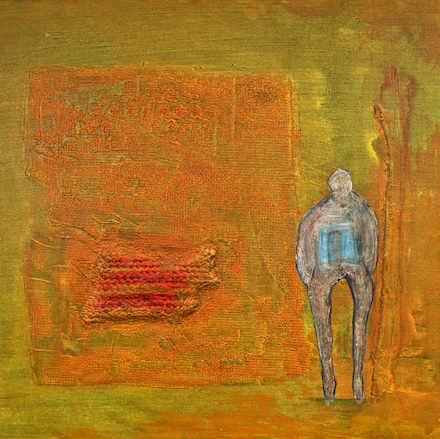
Path to Memorial Chapel (2025), detail of painting © by Kendall Johnson1
The video is faded, but there crouches the legendary Jackson Pollock, leaning over the sprawled glass “canvas,” flipping his stick, dribbling, even throwing paint.2 The camera is angled up from underneath the glass, so that the patterns and layers of splatter are revealed. Some have marveled at how the seemingly random “action” movements yield to fractal analysis, though I’m guessing that tells us more about the world than the painter’s intent.3 As the film shows, he was shifting art production from his head, past his heart, and turning it over to his whole body. Pollock became guided by his hands, shoulders, hips.
For years I taught art with physically and cognitively challenged young people who wrestled with crippling health issues as well. Although I had the correct credentials, it was rough sledding until I finally let go of all I’d been taught about art, art making, and teaching. I learned to begin where they did: with themselves as they were, meeting the materials with which they could play. Bit by bit, then, when it would be useful, I could introduce bits I’d learned—by showing, of course, not telling. We painted and sculpted and showed our work in galleries and exhibitions.
My transition in approach stemmed from a chance encounter in Harlem, N.Y., while I was away from my class and consulting with Harlem Hospital about trauma—my “shadow” career. I stumbled upon director Bill Richards and the hospital’s Horizon studio. Or was perhaps led. I’ve written elsewhere4 about how the program worked miracles by letting patients teach themselves and each other how to best use the materials.5 They figured out what they needed to say, though it often took a long time to say it. The “outsider” patient art began to be shown in expensive Manhattan galleries.
Back in California, once I quit lecturing, quit trying to tell my disabled students how to make art and got out of their way, their work truly began to speak.
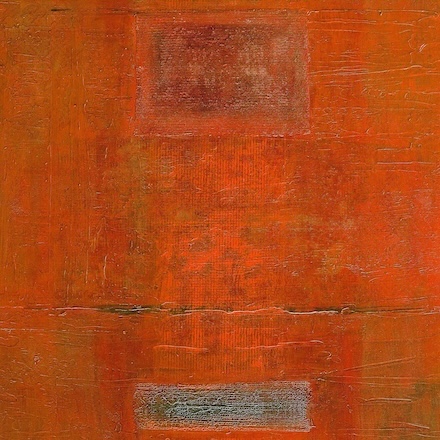
Incandescent Desert (2025), detail of painting © by Kendall Johnson6
Finding Light
Jackson Pollock’s transition to abstract expressionism stemmed from his own similar journey from tradition to innovation. Initially trained by figurative regionalist Thomas Hart Benton, Pollock progressed through a dark primitivist period influenced by his treatment by a Jungian therapist who dealt with deep-seated mythopoetic psychological impulses. Later this deep dive culminated in his tapping into his own body knowledge as a source of aesthetic expression.7
Of course Pollock stood upon the shoulders of others for this. Critic Clement Greenberg cites Pollock as saying that viewing Janet Sobel’s Milky Way (1945)8 shaped his transition from primitive figuration toward all-over (drip) composition. In turn, many artists like Joan Mitchell, Cy Twombly, and Allan Kaprow took Pollock’s impulse in new directions.9 Art can do that. It shapes us.
And through the artwork we all learn. Mitchell herself talks of learning about herself, as well as the world beyond, through the process of painting.10 An interviewer is said to have asked Mitchell when she knows that a painting is finished. When it stops questioning me, she answered.11
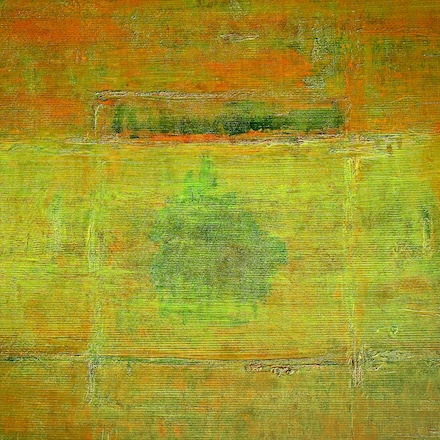
These Potentialities of Space (2025), detail of painting © by Kendall Johnson12
Listening
For a number of years I painted with little direction, at least so I thought. I delighted in beginning with a large blank canvas field, meditating for a bit, and then pouring a rich, viscous white sealing gesso in the middle. I’d move it around, letting it cover the entire canvas with a half inch or so. Then, as it began to harden, I’d work it; playing with the emerging shapes and surfaces, I would watch as the coating would form into more clearly defined texture.
Later, after it was completely dry, I would pour washes of color over the textured surface, watching as the shapes formed. Sometimes I’d work the color by hand, sometimes let it settle in crevices and darken; sometimes I would imbed other materials into it as the canvas seemed to need. Always I would allow it to tell me its story.
It was much later, when the paintings were finished and I’d spent much time wondering what they’d been about, that I came to realize they had embodied by journeys to war zones, disaster scenes, and other places and times I’d been previously unable to speak of emotionally. I found I’d been talking to myself, telling the stories I’d carried silently with my hands, in the language of shape and form.
Shadow Material
For years as a trauma shrink I lectured about the effects of difficult experiences on brain function and behavior. As a former firefighter and combat veteran with impaired memory and a bundle of other PTSD symptoms, I knew something about the compulsion to repeat traumatic circumstance, the manner in which current events could trigger reactions from the past, as well as the path of healing that is as difficult as it is long.
Sometimes I found myself struggling to get through lectures, having difficulty conducting sensitive interventions, and becoming upset with audience members who had never experienced the circumstances I was describing. In retrospect, it was shadow material.
I wasn’t alone in noticing memory surfacing in my work unbidden. I knew at the time it was important, but wasn’t yet ready to grasp why. It took years of work—clinical, academic, and spiritual—for me to appreciate the nature of Carl Jung’s concept of shadow. The mind stores away memories and thoughts it isn’t ready to accept, and develops an entire alternative sense of self that does. Gradually, with support and encouragement, those shadows can emerge safely. Shrinks sometimes help; art can sometimes help. I came to understand the nature of my own projection, with the help of several good therapists and friends. Sobel, Pollock, and Mitchell, among many others, worked with their shadow selves through their art.
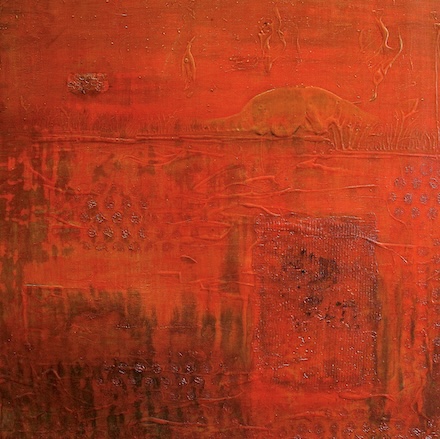
Across Death Valley II (2025), detail of painting © by Kendall Johnson13
Reconsidering Rothko
Some critics dismiss mid-century abstraction as a misguided tool of the marketing system. Yet there is more in Rothko’s work, and seeing that dimension requires a closer, more immersive gaze. We can choose to be guided by postmodern caveats and hesitation, or we can take the artist’s lead and open ourselves more deeply to the experience. After a visit to MoMA I make a few notes:
The lights are dim, the space quiet. A wall of feeling, a painting, devoid of figuration shimmers in the dark. You feel, as much as see, the color, as luminescent as a high Sierra Milky Way splashed across a moonless mountain sky. Even the air in the room feels alive. And the closer you stand, its periphery takes you in. You are the context, you sense meaning beyond words.
You have to look at a Rothko the way the artist intended: up close and intimately personal. You see into the surface, notice the undercoat, swim in the edges that float and disappear. Your mind dismisses presentation theatrics, ignores the price tag, forgets how the CIA may have used the piece as Western propaganda. None of that matters now. The piece envelopes you and holds you in its thrall, shows you what matters, helps you become one.14
Wabi-Sabi and Those Wild Edges
Embracing the truth that everything is falling apart (or in Western parlance, the second law of thermodynamics), the Japanese acknowledge the beauty in impermanence, imperfection, and simplicity.15 The natural order is respected, as are natural things. The experience of beauty includes all aspects which are experienced. Kintsugi, for example, is an art form devoted to repairing broken pottery with gold, leaving the fracture lines highlighted and honored. The brokenness of the piece is acknowledged as an important part of its history. In the same vein, the age of a person is something to be respected, an important part of his or her history.
Also related is the place of shadow in Japanese aesthetics. Novelist Jun’ichirō Tanizaki (1886–1965) has written of this culturally imbedded perspective that is somewhat foreign to Western minds.16 Mystery was anathema to early scientism and industry, something to be solved. Mid-century Modernists, however, had a different take on mystery, and some like Rothko embraced it in their work. He saw it as a path to the sublime. By letting his color, composition, and shape (especially edges) remain indeterminant, he let in light.
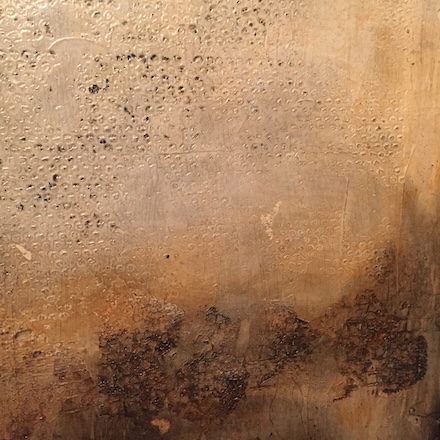
I Think of Dreamtime (2025), detail of painting © by Kendall Johnson17
In Light of Shadow
Today we all suffer from our culture’s obsession with attracting clicks, views, emotional engagement, and—most important—dollars. Yet we artists and writers are better positioned to swim upstream against empty noise, and to use our skills to reduce the deceptive clutter that distracts from our humanity. Our tools can include the use of silence, emptiness, and focus.
Like slowing to really see a Rothko, artists and writers today have the capability18 to imbue their work with deeper meaning by simply slowing down and taking it more seriously. This “slowing” amounts to savoring, appreciating, sharing.
In working with troubled teens, their parents, trauma victims, and folks who have been disappointed by the world, I’ve had to adopt some ways to help them overcome fears and hesitation. They amount to ways to “slow” my writing and artwork as well, to encourage readers and observers to appreciate the work more. I’ve found I can enrich what I make or write by:
- Using ambiguity rather than total closure.
I value interpretation. By using words, phrasing, and images that have multiple possible meanings, I’ve found I empower more viewers and readers to gain access to the work, and to find more applications of the work to their own circumstances and needs. I place my audience in the position to interpret the meaning of the work in ways I might not have anticipated. - Letting the atmosphere and context extend meaning beyond definition or explicit representation.
I try to develop background as much as argument. Laying out the where and when often suggests the what and why. The context provides information which, if spelled out, can heap tedium and bury importance. I’ve found that less, magically, can yield more. - Providing pacing and prompts that allow for moments of contemplation rather than stimulation.
I caution myself to slow to the speed of light. Hard sells impede thinking and processing. If what I’m working on does not benefit from allowing my reader or audience time for consideration and reflection, I have to ask myself whether I should be working on something of greater value. - Allowing the interaction of illumination, material, and the space it needs.
From my teacher days, I try to keep in mind that hearts and brains need to see, touch, and move around. How much depends upon the complexity of the ideas and application, and the cognitive and emotional flexibility that will be needed. I have to ask myself, how can the ideas presented or shown be tailored to the learning needs of the readers and watchers? - Allowing emotional and spiritual depth to emerge indirectly.
I try to remember that feelings and opinions are personal, and that hard sell—however logical and expedient—invites resistance. The best way to encourage subjective shifts is to allow readers and audience to move gradually and come to their own changes naturally.
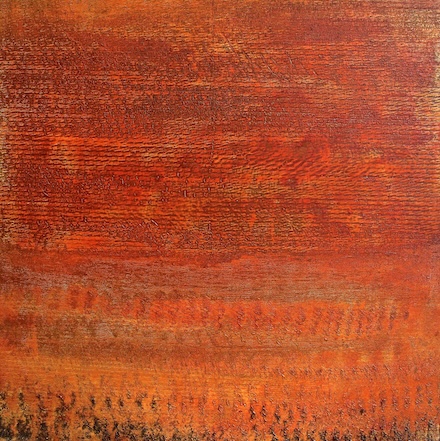
The Quiet Below (2025), detail of painting © by Kendall Johnson19
Meetings with Father Bill
In the dark days following the attack on 9/11, I was called to consult with the crisis teams I’d trained in NYC, to review their operations, suggest new strategies, and provide support. As a trauma specialist, I heard a lot of stories, and many of them stuck. For several years I’d return to California drained, amidst a growing personal crisis that hampered family life, teaching, and my art work. At another artist’s suggestion, I visited the studio of Father Bill Moore.
Fr. Bill was a priest with a gift: he was an artist so talented that his order assigned him the role of outreach to a rough neighborhood of Pomona where his job was to paint. And to talk to the occasional walk-in visitor. Proceeds from his art would feed the order’s various projects. Following my return from yet another assignment to the killing field of Ground Zero, I stumbled into Fr. Bill’s studio. And was stunned.
On the wall hung a large painting that shone with inner light. Vague shapes and deep texture enhanced the field of color that was both simple and complex, every day and luminescent. I was transfixed in a way I hadn’t experienced since standing before an immersive Color Field painting by Mark Rothko, in New York.
It was quiet in the studio, and so I was surprised when I realized that the artist, Fr. Bill, was now standing beside me. I expected a sales greeting, welcoming me to his studio, building rapport, setting me up. Instead, he stood there as silent as I was, just gazing at what he’d done. Finally he asked me quietly what I saw. I was slow to make words, and he patiently waited. I figured he would translate the abstract, but when I asked for explanation, he finally spoke, saying, I’m not sure. And I finally realized that he meant it.
That was the first of many visits, long after I’d finished my work in New York. Over time we talked about what had drawn me there, and what I was getting from just standing there with him, looking. He told me how it was similar for him. How this was his practice, as an artist and as a priest. How he saw his studio as sanctuary, a place set aside for reverence and sustained meditation. How painting was an act of transcendence for him. I came to see his practice as zen-like, and his paintings less like statements about how things are or even might be, and more just as stage setting. Visitors were not so much a congregation as they were the choir.20
On one visit I asked him what some particular shapes and scrapings meant to him.
He smiled and said, again:
I really don’t know.
Citations and Author’s Notes:
Links were confirmed on 13 August 2026.
- Kendall Johnson. Path to Memorial Chapel (2025), mixed media on canvas (detail) from Melting into Air: Desert Words and Images exhibition catalog, Sec. I: Toward Angel Fire, page 18 (Sasse Museum of Art, 2025):
https://heyzine.com/flip-book/6ee1856400.html#page/18 - The documentary Jackson Pollock 51, a classic, was filmed by Hans Namuth and Paul Falkenberg, produced by MoMA, and may be viewed at YouTube:
https://www.youtube.com/watch?v=6cgBvpjwOGo
Namuth and Falkenberg were inspired to capture “action painting” on film following Martha Holmes’s photo spread in Life Magazine (Volume 27, Number 6; 8 August 1949) that galvanized public attention. Her article is available at Internet Archive:
https://archive.org/details/Life-1949-08-08-Vol-27-No-6/page/42/mode/2up - Pollock’s “action painting” became an iconic fixture in the history of American 20th-century abstraction. Those who are interested can find out more in Jackson Pollock: Long Story Short (eight-minute video):
https://www.youtube.com/watch?v=HksS8F4yx_8 - See “Incident in Harlem” in my nonfiction book Chaos & Ash (Pelekinesis, 2020). To my sorrow, the program has since been absorbed back into the new medical organization.
- Richard’s work at the hospital culminated in an exhibition at, among other venues along the east coast, the Rosenwald-Wolf Gallery at The University of the Arts, Philadelphia. The exhibition catalog for Renewing the Spirit: Paintings from the Harlem Horizon Art Studio is available at Internet Archive:
https://archive.org/details/renewingspiritpa00rose/mode/2up - Kendall Johnson. Incandescent Desert (2025), mixed media on canvas (detail) from Melting into Air: Desert Words and Images exhibition catalog, Sec. V: Out of the Desert, page 67 (Sasse Museum of Art, 2025). Note: The image in the catalog was inadvertently published upside down and with more color saturation than the original painting, as it appears above in this essay.
- For an in-depth discussion of this remarkable transition, see Jackson Pollock: An American Saga by Gregory White Smith and Steven Naifeh. This biography received controversial reviews, but taken lightly, it does nicely capture Pollock’s shift from artmaking as telling to artmaking as being.
- For a fascinating and accessible video on Janet Sobel narrated by Alex Halberstadt, courtesy of the Museum of Modern Art in New York, see The Ukrainian artist who dripped paint before Jackson Pollock:
https://www.youtube.com/embed/x1Y-iC3AZik
Unfortunately, the critic Greenberg—and most of the 1950-60 New York art scene—went on to sideline Sobel and other female Expressionists who are only now, more than half a century later, being more properly acknowledged. - Readers may be interested in the development of the “movement” Fluxus, which incorporates action art with performance and uncertainty. See Karen Kedmey’s article “What Is Fluxus?” at Artsy (14 January 2014):
https://www.artsy.net/article/artsy-editorial-fluxus-movement-art-museums-galleries - David Zwirner (Art Gallery and Books) offers a fascinating exploration of Mitchell’s life and painting process:
https://www.davidzwirner.com/artists/joan-mitchell#biography
See also David Zwirner’s richly detailed page about their 2019 exhibition Joan Mitchell: I carry my landscapes around with me:
https://www.davidzwirner.com/exhibitions/2019/i-carry-my-landscapes-around-me - Attributed in the curators’ statements from the exhibition catalogue The Paintings of Joan Mitchell, with essays by Jane Livingston, Linda Nochlin, and Yvette Lee, published in 2002 by the Whitney Museum of American Art, University of California Press:
https://www.joanmitchellfoundation.org/joan-mitchell/citations/the-paintings-of-joan-mitchell - Kendall Johnson. These Potentialities of Space (2025), mixed media on canvas (detail) from Melting into Air: Desert Words and Images exhibition catalog, Sec. V: Out of the Desert, page 61 (Sasse Museum of Art, 2025):
https://heyzine.com/flip-book/6ee1856400.html#page/61 - Kendall Johnson. Across Death Valley II (2025), mixed media on canvas (detail) from Melting into Air: Desert Words and Images exhibition catalog, Sec. III: Across Death Valley, page 37 (Sasse Museum of Art, 2025):
https://heyzine.com/flip-book/6ee1856400.html#page/37 - One of my favorite Rothko iconic Color Field paintings, Untitled (Blue, Green, and Brown) (1952), may be viewed at the curated Instagram page Daily Rothko (28 December 2024):
https://www.instagram.com/p/DEIXbCrRu2O/?hl=en
And elsewhere online, a favorite quotation by the artist about silence: “By 1950, Rothko resisted explaining the meaning of his work. ‘Silence is so accurate,’ he said, fearing that words would only ‘paralyze’ the viewer’s mind and imagination.” From PBS American Masters (16 October 2019), “Rothko: Pictures Must Be Miraculous” by Isabelle Dervaux, originally published by the National Gallery of Art for the exhibition Mark Rothko (1998):
https://www.pbs.org/wnet/americanmasters/essay-from-the-national-gallery-of-art/11846/ - Two good resources for Western readers who wish to explore wabi-sabi are Leonard Koren’s books: Wabi-Sabi for Artists, Designers, Poets & Philosophers (updated 2008) and Wabi-Sabi: Further Thoughts (2015), both published by Imperfect Press.
MacQ Publisher’s Note: Here’s a snippet from an online review, “At first I thought the book would be about that green mustard they serve with sushi. It’s much more profound than that, and was just what I needed to hit the spot.” Quoted in designer Rob Forbes’s review at his blog, Studio Forbes:
https://www.studioforbes.com/blog-posts/book-review-wabi-sabi-by-leonard-koren - Tanizaki’s essay “In Praise of Shadows” was written in 1933, and published in the December 1933 and January 1934 issues of Keizai Ōrai, a notable monthly magazine in Tokyo that served as a forum for economic commentary, social issues, and literary criticism. The essay was translated into English by Thomas J. Harper and Edward G. Seidensticker in 1954, and published by Leete’s Island Books in 1977.
While the essay is available online, this version does not have the very helpful illustrations of the Leete’s Island print version:
https://neeta.works/on-graphic-design/readings/Tanizaki-In_Praise_of_Shadows.pdf - Kendall Johnson. I Think of Dreamtime (2025), mixed media on canvas (detail) from Melting into Air: Desert Words and Images exhibition catalog, Sec. IV: Into Amboy Crater, page 48 (Sasse Museum of Art, 2025):
https://heyzine.com/flip-book/6ee1856400.html#page/48 - The “negative capability,” the poet Keats called it, to see with our hearts and spirit, not just with our heads.
- Kendall Johnson. The Quiet Below (2025), mixed media on canvas (detail) from Melting into Air: Desert Words and Images exhibition catalog, Sec. II: Entering Utah, page 27 (Sasse Museum of Art, 2025):
https://heyzine.com/flip-book/6ee1856400.html#page/27 - MacQ Publisher’s Note: I recommend that readers follow up this enlightening essay with Johnson’s lovely CNF “Father Bill’s Studio: Seven Vignettes” (in the Gratitude Issue of MacQueen’s Quinterly, November 2023):
http://www.macqueensquinterly.com/MacQ20X/Johnson-Father-Bill.aspx
Publisher’s Notes:
- Part 4 of this Writing for Light series by Dr. Kendall Johnson is published in Issue 32 of MacQueen’s Quinterly (aka MacQ): Returning to Listen, which includes seven of Johnson’s artworks.
Part 3 is published in Issue 31 of MacQ: Writing Fire, which includes five mixed-media paintings by Johnson.
Part 2 also appears in Issue 31 of MacQ: Finding Hope in Darkness, which includes artworks by Kendall Johnson, a sculpture by David Kimball Anderson, and a painting by Dr. Wesley Hurd.
Part 1 appears in Issue 30X (December 2025) of MacQ: Writing in the Dark, which includes five sepia photographs by Johnson. - The seven essays of Johnson’s series Writing for Vision are published in MacQueen’s Quinterly online (Issues 23 thru 27), as well as in a printed collection released by MacQ in August 2025. The book also includes 24 of his visual artworks in full color and an introduction by essayist and poet Kate Flannery, as described in Issue 29 of MacQ:
Writing for Vision: Voicing the New Wild - The six essays of Johnson’s Writing to Heal series are published in MacQueen’s Quinterly online (Issues 16-19, 20X, and 22), as well as in a printed collection released by MacQ in May 2024. The book also includes a few of his poems and 21 of his artworks in full color, as described in Issue 23:
Writing to Heal: Self-Care for Creators
Kendall Johnson
grew up in the lemon groves in Southern California, raised by assorted coyotes and bobcats. A former firefighter with military experience, he served as traumatic stress therapist and crisis consultant—often in the field. A nationally certified teacher, he taught art and writing, served as a gallery director, and still serves on the board of the Sasse Museum of Art, for whom he authored the museum books Fragments: An Archeology of Memory (2017), an attempt to use art and writing to retrieve lost memories of combat; and Dear Vincent: A Psychologist Turned Artist Writes Back to Van Gogh (2020), which is also available in print. He holds national board certification as an art teacher for adolescents to young adults.
Dr. Johnson retired from teaching and clinical work a few years ago to pursue painting, photography, and writing full time. In that capacity he has written a book on art history and seven books of visual art, poetry, and/or essays, including most recently Writing for Vision: Voicing the New Wild (MacQ, August 2025); and Prayers for Morning: Twenty Quartets, a collaboration with poets Kate Flannery and John Brantingham released on Christmas Day, 2024 by MacQ.
MacQ also published Dr. Johnson’s hybrid collection of essays, memoir, poetry, and visual art: Writing to Heal: Self-Care for Creators (May 2024), which was named a category finalist in 2025 for the Eric Hoffer Book Award. His memoir collection Chaos & Ash was released from Pelekinesis in 2020, his Black Box Poetics from Bamboo Dart Press in 2021, and his The Stardust Mirage from Cholla Needles Press in 2022.
His Fireflies series is published by Arroyo Seco Press: Fireflies Against Darkness (2021), More Fireflies (2022), The Fireflies Around Us (2023), and Fireflies for These New Dark Ages (30 November 2025).
His shorter work has appeared in Chiron Review, Cultural Weekly, Literary Hub, MacQueen’s Quinterly, Quarks Ediciones Digitales, and Shark Reef; and was translated into Chinese by Poetry Hall: A Chinese and English Bi-Lingual Journal. Johnson served four years as a contributing editor for the Journal of Radical Wonder.
More on the Web: By, About, and Beyond
⚡ Dark News I-III (a trio of Fireflies from the fourth book of the series, Fireflies for These New Dark Ages) by Kendall Johnson in Issue 30 of MacQueen’s Quinterly (September 2025)
⚡ Dark News IV-VI (a second trio of Fireflies) by Johnson in MacQueen’s Quinterly (Issue 30X, December 2025)
⚡ Seeing Beyond the Clamorous Now, an essay and paintings by Johnson in Issue 25 of MacQueen’s Quinterly (September 2024); nominated by MacQ for the Pushcart Prize
⚡ Through a Curatorial Eye: The Apocalypse This Time, an essay and paintings by Johnson in Issue 19 of MacQueen’s Quinterly (August 2023); nominated by MacQ for the Pushcart Prize
⚡ Kendall Johnson’s Black Box Poetics is out today on Bamboo Dart Press, an interview by Dennis Callaci in Shrimper Records blog (10 June 2021)
⚡ Self Portraits: A Review of Kendall Johnson’s Dear Vincent, by Trevor Losh-Johnson in The Ekphrastic Review (6 March 2020)
⚡ On the Ground Fighting a New American Wildfire at Literary Hub (12 August 2020), a selection from Kendall Johnson’s memoir collection Chaos & Ash (Pelekinesis, 2020)
⚡ A review of Chaos & Ash by John Brantingham in Tears in the Fence (2 January 2021)
| Copyright © 2019-2026 by MacQueen’s Quinterly and by those whose works appear here. | |
| Logo and website designed and built by Clare MacQueen; copyrighted © 2019-2026. | |
|
Data collection, storage, assimilation, or interpretation of this publication, in whole or in part, for the purpose of AI training are expressly forbidden, no exceptions. |
At MacQ, we take your privacy seriously. We do not collect, sell, rent, or exchange your name and email address, or any other information about you, to third parties for marketing purposes. When you contact us, we will use your name and email address only in order to respond to your questions, comments, etc.