
|
||
 |
|

| Issue 33: | August 2026 |
| Essay: | 1,151 words |
| References: | 784 words |
By Colleen M. Farrelly
Cheribun: A Craft Perspective
Cheribun is a relatively new prosimetrum comprised of prose and a verse form called cherita.1 Invented by Malay poet ai li in 1997, the cherita is a haiku-like structured poem of six lines arranged in three stanzas, with one line in the first stanza, two lines in the second, and three in the third.2 As a form, cheribun emerged in 2021 through “The Writer’s Cabin” by Margaret Dornaus, published by MacQueen’s Quinterly (aka MacQ).3 Since then, writers have explored variations of the form including long-form prose4 with a single cherita (“Quindaro, Kansas” by Marceline White, with 281 words of prose5); polyptych with multiple cherita (“Memento Mori” by Daryl Scroggins6); cherita that is braided through prose (“The Things I Do for Porn”7); and variations that combine flash and poetic styles (“The Permanence of Light” by Julie Sellers8).
While related, cheribun craft diverges from haibun craft on a few key considerations. To classify dominant cheribun composition trends and examine preserved haibun craft elements, I analyzed MacQ’s archives of 97 cheribun (January 2022 through June 2026), paying special attention to prose styles (flash prose vs. prose poem), cherita styles (lyrical vs. narrative poetic form), and typical haibun elements: the ma (breathing room between prose and cherita), the kire (the turning within cherita that’s more subtle than the sharp turn in haiku), and the linking and shifting among title, prose, and poem. In addition, I logged anomalous varieties, including braided, multi-cherita, and micro versions of the form. Initially, the cheribun sample was split according to contest finalist/winner status; however, craft trends rarely differed across groups, suggesting that top cheribun simply execute craft at a higher level than semi-finalist pieces.
Prose analysis suggests most cheribun follow flash-style prose rather than poetic prose. However, narrative prose further split between flash fiction and haikai-style conventions, likely a reflection of contributions from both the flash community and the haibun community. One of only five instances of second-person perspective within examined cheribun, Gary S. Rosin’s “Birthdays of the Dead” exemplifies many key elements of cheribun prose rooted in flash and haikai traditions: compressed imagery, short length, lack of intellectualizing a moment, and inclusion of a singular storyline:
Years ago, your soulmate died, but your souls remain connected. The home you shared is full of recuerdos, all things that remind you of the treasure of your life together. You see your faces. You hear the music and the laughter. You dream again the dreams. You feel the intimacy. On Día de los Muertos, you build an ofrenda, an altar and offerings to welcome your beloved home.9
In contrast, prose poem components are less common (only ~30% of the total of 97 cheribun), but they offer potential craft elements to handle starker, rawer imagery and darker storylines, as exemplified by Jerome Berglund’s urban portrait in “Under the Sun”:
Beggars at every corner stoplight, median, highway entrance ramp, huddled beneath the awnings, before the vestibules of each business, beacons, shining pillars to exceptionalism ...10
Berglund uses lists, light alliteration, rhythm, and light personification, which are rare among flash-style cheribun. However, they are more common among cheribun that follow lyrical prose standards. This heightened language pulls the reader into a vignette free of plot but immersed in imagery.
Similarly, the cherita trends mirror this division, though more evenly split between lyrical and narrative verse than cheribun prose. When the cherita veers narrative in nature, it typically completes the prose storyline with compressed language and imagery (often including a final turn like the kire of haiku). As with free verse, cherita occasionally employ lines that extend across the page (Oz Hardwick’s “Last Ride in the Dead Zone”11) while others are sleek and minimalistic like haiku (as in Kat Lehmann’s “Take Only Photos”12 and Peter Jastermsky’s “Fishboy”13). Rosin’s “Birthdays of the Dead” exemplifies a narrative-ending cherita of medium-sized line length with economical use of poetic devices like enjambment:
You don’t count birthdays,
but Días de los Muertos,
each new ofrenda.

Días keep adding up ... soon
you will cross over, join

the other half of your soul.14
However, when the cherita leans lyrical, it often contains elements of alliteration, assonance, enjambment, and figurative language. Some even include rhyme (as in Cynthia Anderson’s “So Many Days”15) or simile and metaphor (as in Oz Hardwick’s winning “Adventures in Experiential Limnology”16). However, most lyrical cherita use these tools sparingly. Berglund’s slender cherita that ends “Under the Sun” employs alliteration and a haiku-like kire:
leg of lamb

on
the butcher
block

where credit
is due17
Beyond prose and cherita styles, cheribun preserves several key craft elements of haibun. Breathing room between prose and poem—the ma—is present in nearly every cheribun, as is a turning of the cherita within the last line(s) functioning similarly to a kire. However, these elements are subtler than those in a typical haibun, particularly the kire component. While most cheribun turn within the cherita section, this turn is gradually introduced or spans multiple lines; within haibun, the haiku kire is tighter.
The Holy Trinity of Haibun, as Roberta Beary has noted, includes the interplay of title, prose, and haiku.18 Cheribun may also be adopting this aesthetic, at least in the short term. These elements interplay within many cheribun written by haibun poets (as in Peggy Bilbro’s “In Then Out”19 and Beary’s own “A Narrator’s Qualms in Quest of They/Them Pronouns”20) and seem to be coalescing in cheribun craft as flash fiction and haibun writers influence each other’s styles.21 At this point, though, it is unknown if this haibun convention will become standard practice in cheribun.
Given recent trends incorporating experimental prose and haikai forms in haibun, it would be reasonable to expect cheribun variation, as well. However, few extant cheribun mix experimental traditions of prose or poetry. For example, only one “code” cheribun, combining computer code with prose and verse, has been published online to date: “#Still Compiling” by Colleen M. Farrelly.22 Some concrete cheribun exist (see Hazel Hall’s “Her Morning Walk”23 which includes open-field verse, or Colleen M. Farrelly’s “Crossing Paths”24) as do braided forms (see Kat Lehmann’s “Take Only Photos”25 or Scott Wiggerman’s “When I Knew: Second Grade”26 or Colleen M. Farrelly’s “Necessary and Sufficient Conditions”27). Hermit crab prose; retelling in prose, grid, or Venn Diagram cherita; burning cheribun; formal-verse cheribun; one-bun; and other varieties have yet to appear in the cheribun literature. As these exist within the haibun form,28 it’s likely that cheribun’s prose will undergo a transformation period as writers experiment with the form’s possibilities.29
Further, as cheribun evolves, its roots in flash, haikai, and free-verse traditions suggest a potential adoption across disparate communities. For now, cheribun remains an emerging form yet to crystalize its craft, offering opportunities for those wishing to shape this hybrid’s canon.
Cheribun Analysis Score Sheets
Copyrighted © 2026 by Colleen M. Farrelly
| For larger view, click each image to open resizable PDF in new window. | ||
1. Winners & Finalists (2 pages) 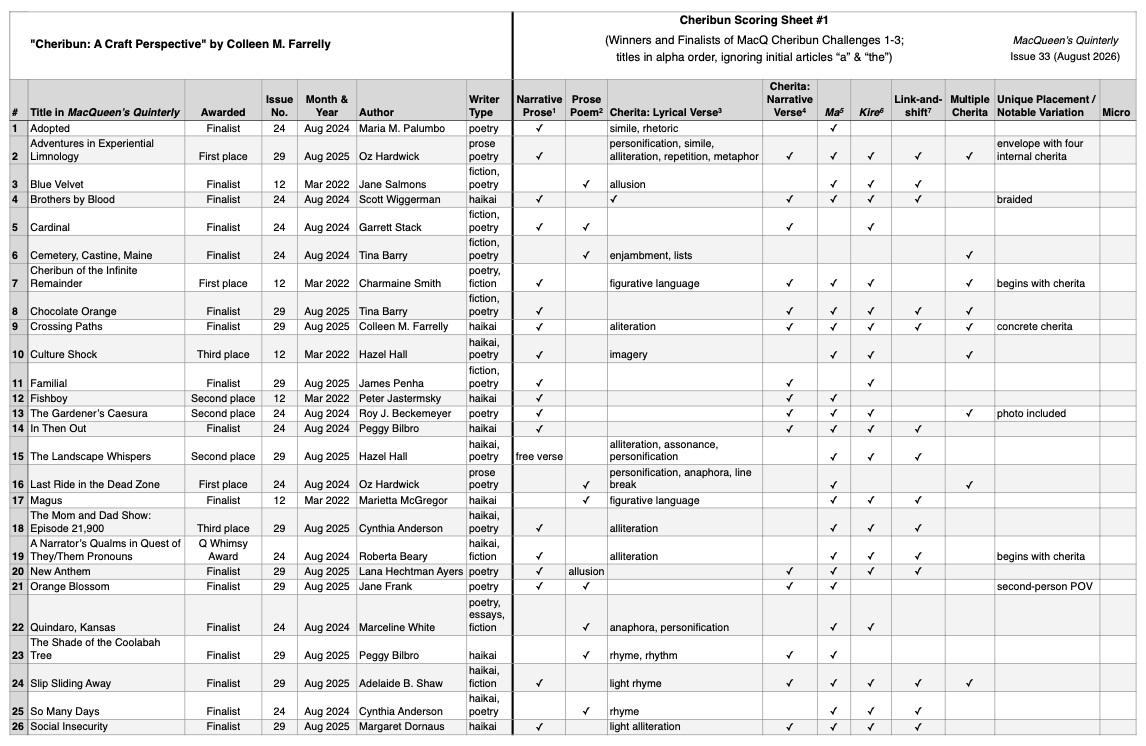 |
2. Other Cheribun (4 pages) 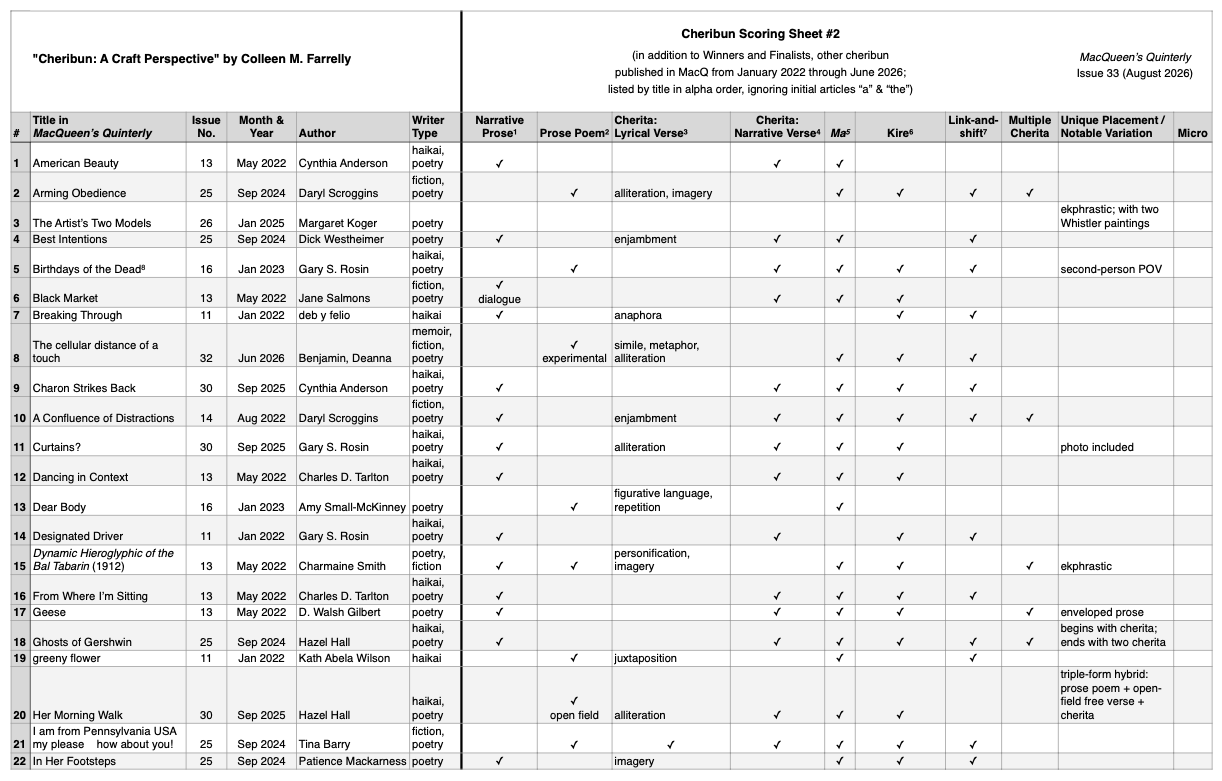 |
|
3. Master List, Titles (5 pages) 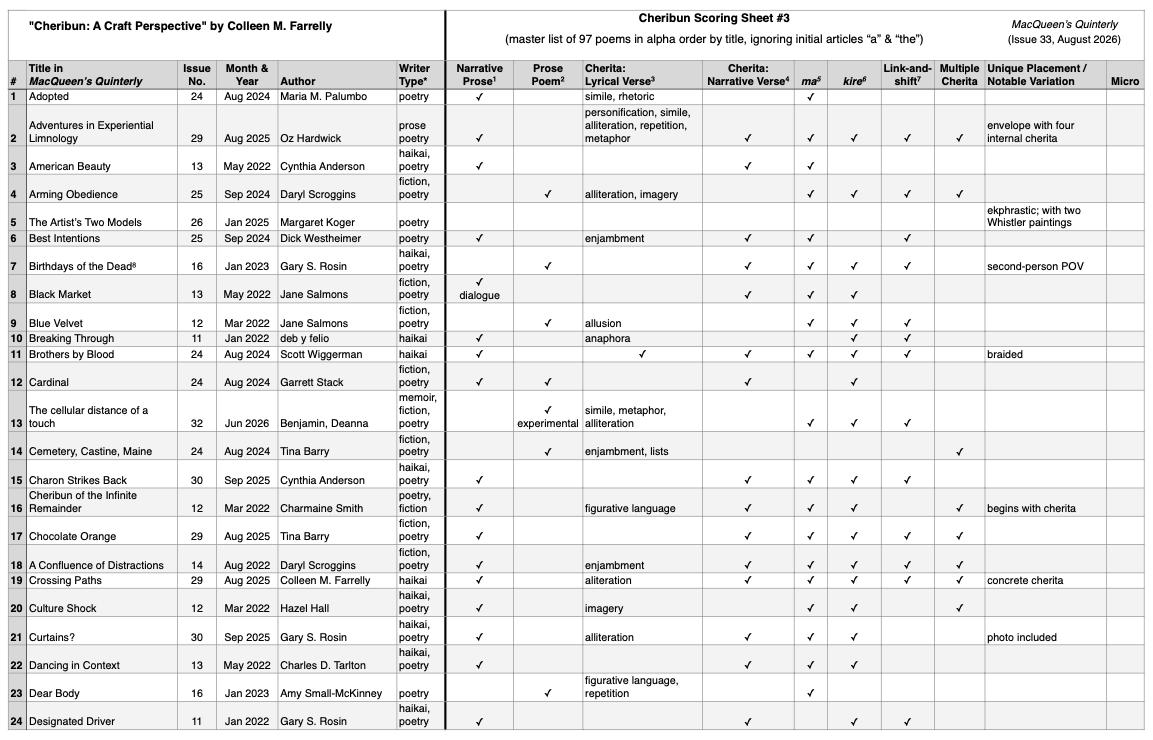 |
4. Master List, Authors (5 pages) 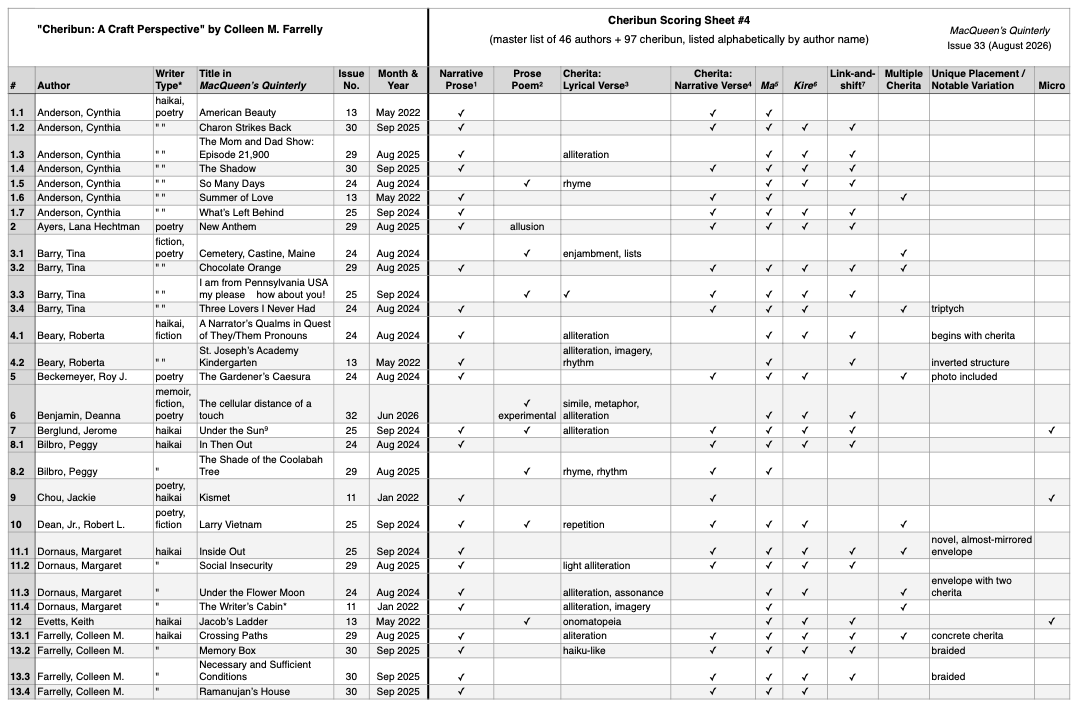 |
|
References:
Unless otherwise noted below, links were accessed by the author on 25 April 2026, and reconfirmed by the publisher in July 2026. Beyond the first reference note, the journal name MacQueen’s Quinterly is abbreviated as MacQ.
- Clare MacQueen, “MacQ’s First Cheribun!” in MacQueen’s Quinterly (Issue 11, January 2022):
http://www.macqueensquinterly.com/MacQ11/Cheribun-Feature.aspx - ai li, “The Original and Official Guidelines” on the cherita home page; link retrieved on 18 July 2026:
https://www.thecherita.com - Margaret Dornaus, “The Writer’s Cabin” in MacQ (Issue 11, January 2022):
http://www.macqueensquinterly.com/MacQ11/Dornaus-Cabin.aspx - In the flash-fiction community, long form typically refers to stories upwards of 1200 words. The annual Best Microfiction anthology defines microfiction as no longer than 400 words. However, in the haikai community, “long form” generally means >250 words: “most haibun range from well under 100 words to 200 or 300” as defined by the Haiku Society of America (HSA) in September 2004. Yet the HSA’s 2026 definition no longer refers to word length.
Links retrieved on 19 July 2026:
https://www.hsa-haiku.org/hsa-definitions-2004.html
https://www.hsa-haiku.org/hsa-definitions.html - Marceline White, “Quindaro, Kansas” in MacQ (Issue 24, August 2024):
http://www.macqueensquinterly.com/MacQ24/White-Quindaro.aspx - Daryl Scroggins, “Memento Mori” in MacQ (Issue 13, May 2022):
http://www.macqueensquinterly.com/MacQ13/Scroggins-Memento-Mori.aspx - Scott Wiggerman, “The Things I Do for Porn” in MacQ (Issue 25, September 2024):
http://www.macqueensquinterly.com/MacQ25/Wiggerman-Do-for-Porn.aspx - Julie Sellers, “The Permanence of Light” in MacQ (Issue 25, September 2024):
http://www.macqueensquinterly.com/MacQ25/Sellers-Permanence.aspx - Gary S. Rosin, “Birthdays of the Dead” in MacQ (Issue 16, January 2023):
http://www.macqueensquinterly.com/MacQ16/Rosin-Birthdays.aspx - Jerome Berglund, “Under the Sun” in MacQ (Issue 25, September 2024):
http://www.macqueensquinterly.com/MacQ25/Berglund-Under-Sun.aspx - Oz Hardwick, “Last Ride in the Dead Zone” in MacQ (Issue 24, August 2024):
http://www.macqueensquinterly.com/MacQ24/Hardwick-Last-Ride.aspx - Kat Lehmann, “Take Only Photos” in MacQ (Issue 25, September 2024):
http://www.macqueensquinterly.com/MacQ25/Lehmann-Only-Photos.aspx - Peter Jastermsky, “Fishboy” in MacQ (Issue 12, March 2022); link retrieved on 20 July 2026:
http://www.macqueensquinterly.com/MacQ12/Jastermsky-Cheribun-Fishboy.aspx - Gary S. Rosin, “Birthdays of the Dead” in MacQ (Issue 16, January 2023):
http://www.macqueensquinterly.com/MacQ16/Rosin-Birthdays.aspx - Cynthia Anderson, “So Many Days” in MacQ (Issue 24, August 2024):
http://www.macqueensquinterly.com/MacQ24/Anderson-Many-Days.aspx - Oz Hardwick, “Adventures in Experiential Limnology” in MacQ (Issue 29, August 2025):
http://www.macqueensquinterly.com/MacQ29/Hardwick-Adventures.aspx - Jerome Berglund, “Under the Sun” in MacQ (Issue 25, September 2024):
http://www.macqueensquinterly.com/MacQ25/Berglund-Under-Sun.aspx - Roberta Beary, “Why I Write Haibun, or The Holy Trinity of Haibun” in MacQ (Issue 1, January 2020):
http://www.macqueensquinterly.com/MacQ1/Beary-Holy-Trinity-Haibun.aspx - Peggy Bilbro, “In Then Out” in MacQ (Issue 24, August 2024):
http://www.macqueensquinterly.com/MacQ24/Bilbro-In-Out.aspx - Roberta Beary, “A Narrator’s Qualms in Quest of They/Them Pronouns” in MacQ (Issue 24, August 2024):
http://www.macqueensquinterly.com/MacQ24/Beary-Narrators-Qualms.aspx - As indicated in Colleen M. Farrelly’s Cheribun Analysis Scoring Sheets, link-and-shift occurs frequently, as in ~63% of the cheribun (i.e., 61 of the 97 total); link below was retrieved in August 2026:
http://www.macqueensquinterly.com/Images33/Farrelly-Score-Sheet1.pdf - Colleen M. Farrelly, “#Still Compiling” in MacQ (Issue 32, June 2026):
http://www.macqueensquinterly.com/MacQ32/Farrelly-Still-Compiling.aspx - Hazel Hall, “Her Morning Walk” in MacQ (Issue 30, September 2025):
http://www.macqueensquinterly.com/MacQ30/Hall-Morning-Walk.aspx - Colleen M. Farrelly, “Crossing Paths” in MacQ (Issue 29, August 2025):
http://www.macqueensquinterly.com/MacQ29/Farrelly-Crossing-Paths.aspx - Kat Lehmann, “Take Only Photos” in MacQ (Issue 25, September 2024):
http://www.macqueensquinterly.com/MacQ25/Lehmann-Only-Photos.aspx - Scott Wiggerman, “When I Knew: Second Grade” in MacQ (Issue 30, September 2025):
http://www.macqueensquinterly.com/MacQ30/Wiggerman-Second-Grade.aspx - Colleen M. Farrelly, “Necessary and Sufficient Conditions” in MacQ (Issue 30, September 2025):
http://www.macqueensquinterly.com/MacQ30/Farrelly-Necessary.aspx - Colleen M. Farrelly, “The Haibun Zoo: A Guide to Current Rare Haibun Forms” in MacQ (Issue 30X, December 2025):
http://www.macqueensquinterly.com/MacQ30X/Farrelly-Haibun-Zoo.aspx - Publisher’s Note: Since the 1960s–1980s, experimentation in the haibun form has been driven in part by contemporary variations of the haiku. However, due to ai li’s prohibitions on tinkering, the cherita form has not changed since 1997, except by allowing variations in ordering the three stanzas. The cheribun form is less than five years old, with only 97 published in MacQueen’s Quinterly as of June 2026, five of which are by MacQ Contributing Editor Gary S. Rosin. “A more interesting question,” as Rosin suggests, “is whether the needs of the cheribun form might drive variations in the cherita ... or would that be mutations?” (April 2026).
Colleen M. Farrelly
is a mathematician, poet, and haibun/cheribun scholar who lives in Miami, Florida, and enjoys being a digital nomad. Her first full-length poetry collection, The Haibun Laboratory, will be released by Cuttlefish Press this summer. Her writing is forthcoming in About Place Journal, Consequence Forum, and MoonPark Review; and has appeared in cattails journal, Contemporary Haibun Online, #FemkuMag, Frogpond, Haibun Today, MacQueen’s Quinterly, Modern Haiku, The Other Bunny, Under the Bashō, and Wales Haiku Journal among others.
Two of her haibun were nominated by #FemkuMag for the Pushcart Prize. Her work has been nominated for Touchstone and Dwarf Star Awards, has won honorable mention in several contests, and appears in telling the bees: The Red Moon Anthology of English-Language Haiku 2024.
Dozens of her papers on computational mathematics have been published, and she’s co-author of two mathematics textbooks: with Yaè Ulrich Gaba, The Shape of Data: Geometry-Based Machine Learning and Data Analysis in R (San Francisco: No Starch Press, 2023); and with Franck Kalala Mutombo, Modern Graph Theory Algorithms with Python (UK: Packt Publishing, 2024).
More on the Web: By, About, and Beyond
⚡ Engaging the head and the heart: why scientists turn to poetry by Josie Glausiusz in Nature (8 April 2026); Colleen M. Farrelly is among the scientists who “use verse to visualize complex problems or translate the wonders of science for wider audiences.”
⚡ The Haibun Zoo: A Guide to Current Rare Haibun Forms by Colleen M. Farrelly in MacQueen’s Quinterly (Issue 30X, December 2025)
⚡ Weathering the Storm, a sci-bun by Farrelly in Rattle Poets Respond (30 September 2025)
| Copyright © 2019-2026 by MacQueen’s Quinterly and by those whose works appear here. | |
| Logo and website designed and built by Clare MacQueen; copyrighted © 2019-2026. | |
|
Data collection, storage, assimilation, or interpretation of this publication, in whole or in part, for the purpose of AI training are expressly forbidden, no exceptions. |
At MacQ, we take your privacy seriously. We do not collect, sell, rent, or exchange your name and email address, or any other information about you, to third parties for marketing purposes. When you contact us, we will use your name and email address only in order to respond to your questions, comments, etc.