
|
|
 |
|

| Issue 34: | Sept. 2026 |
| CNF: | 293 words |
By Roy J. Beckemeyer
Uses and Meanings: Liturgy
Liturgy:    First known use, 1560
Litigious:  First known use, 14th-century Middle English
Linguistic: First known use, circa 1837
“I see it as a Liturgical figure,” my words went unanswered, skeptical gazes the only commentary. In the days of the word’s origin, faithful clergy would have shouted,“Heresy,” my statement sparking enough flame that the Inquisitors among them would have immediately begun stacking the kindling. In these enlightened times, it’s more likely some fellow Christian with litigious tendencies would take me to court. Especially if that follower of Christ fully believed in Transubstantiation.
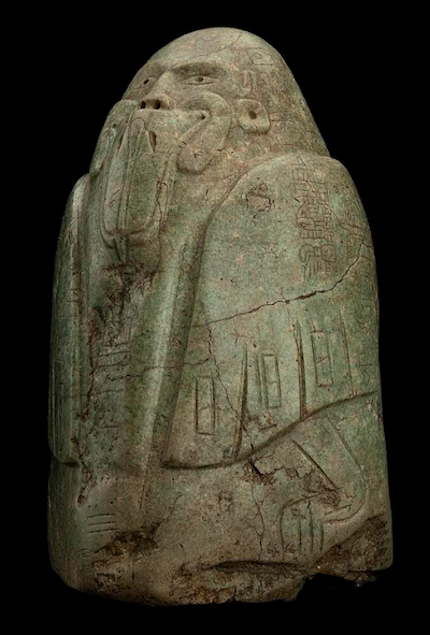
Linguists, using the carved shaman-statuette’s hieroglyphs to decipher and resurrect the old fellow’s story, have worried the linguistic syllabograms and logograms until they revealed this irony: the shaman was only making a case (similar to mine) of his own. He enjoined his warrior-king to perform the required ritual of that royal self’s blood-letting, so once more to prove his kingly worthiness to reign.
The shaman, in the splendid raiment of his companion spirit animal, the boatbill bird, held up the statuette, his avatar, and read, from the columns of incised ancient glyphs, the words that declared the power of this rite of the King: sharing his own royal blood with his faithful followers—this Tuxtla Liturgy.
Author’s Notes:
- The Tuxtla Statuette is a small (about six inches) Mesoamerican carving made of jadeite diopside, portraying a shaman wearing a bird costume and a half mask resembling a boatbill heron’s bill. The carving is incised with nearly 70 glyphs. Most of the signs are syllabograms—signs that represent a syllable; some are logograms—signs that represent words or morphemes.
- The first-use dates for the words liturgy, litigious, and linguistic are from Merriam-Webster’s Unabridged Dictionary online, accessed 7 May 2026.
Publisher’s Note:
Image above is a cropped version of a photograph by Adrian Hernandez, Estatuilla de Tuxtla (January 2018), downloaded from Wikimedia and used here under CC BY-SA 4.0 license.
The Smithsonian Natural History Museum online has three dozen images of the statuette (from all angles), which had been on display in the Objects of Wonder Exhibition 2017-2024. Exhibit label identified the carving as “Epi-Olmec, from Veracruz, Mexico (AD 162).”
See also “What Secrets Does This 1,800-Year-Old Carved Stone Hold?” by Jack Herrera in Smithsonian magazine (October 2021).
Roy J. Beckemeyer’s
poetry collections include The Currency of His Light (Turning Plow Press, 2023) and Mouth Brimming Over (Blue Cedar Press, 2019). Stage Whispers (Meadowlark Books, 2018) won the 2019 Nelson Poetry Book Award. Amanuensis Angel (Spartan Press, 2018) comprises ekphrastic poems inspired by modern artists’ depictions of angels. His first book, Music I Once Could Dance To (Coal City Press, 2014), was a 2015 Kansas Notable Book. With Caryn Mirriam-Goldberg, he co-edited Kansas Time+Place: An Anthology of Heartland Poetry (Little Balkans Press, 2017). His poetry has been nominated for the Pushcart Prize (2015, 2020, and 2024) and for Best of the Net (2018), and was selected for The Best Small Fictions 2019.
A retired engineer and scientific journal editor, Beckemeyer is also a nature photographer who, in his spare time, researches the mechanics of insect flight and the Paleozoic insect fauna of Kansas, Oklahoma, and Alabama. He lives in Wichita, Kansas, where he and his late wife would have celebrated their 65th anniversary in November this year.
Please visit author’s website for more information about his books, as well as links to selected works, and to interviews and readings (scroll down his About page for the latter link-list).
More on the Web: By, About, and Beyond
⚡ The Gardener’s Caesura, ekphrastic cheribun by Beckemeyer in homage to his wife, Patricia (1942–2024); awarded Second Place in MacQ’s Cheribun Challenge #2 and published in MacQueen’s Quinterly (Issue 24, August 2024)
⚡ Megarhyssa, ekphrastic poem by Beckemeyer in Issue 14 of MacQueen’s Quinterly (August 2022), nominated by MacQ for the Pushcart Prize
⚡ The Color of Blessings in Issue 5 of MacQueen’s Quinterly (October 2020), nominated by MacQ for the Pushcart Prize
⚡ Featured Artist in KYSO Flash (Issue 12, Summer 2019); showcasing Beckemeyer’s poetry, prose poetry, and insect photography
⚡ Words for Snow, a prose poem in KYSO Flash (Issue 9, Spring 2018), which was selected for reprinting in The Best Small Fictions 2019
| Copyright © 2019-2026 by MacQueen’s Quinterly and by those whose works appear here. | |
| Logo and website designed and built by Clare MacQueen; copyrighted © 2019-2026. | |
|
Data collection, storage, assimilation, or interpretation of this publication, in whole or in part, for the purpose of AI training are expressly forbidden, no exceptions. |
At MacQ, we take your privacy seriously. We do not collect, sell, rent, or exchange your name and email address, or any other information about you, to third parties for marketing purposes. When you contact us, we will use your name and email address only in order to respond to your questions, comments, etc.