
|
||
 |
|

| Issue 30X: | Dec. 2025 |
| Essay: | 1,955 words |
| + Poems: | 72 & 66 words |
| [MacQ’s Note: | 112 words] |
By Kurt Luchs
H.D.
—Excerpted from Tributaries: Essays & Verses Flowing From & Celebrating Favorite Poems*
Evening
By H.D.
The light passes
from ridge to ridge,
from flower to flower—
the hepaticas, wide-spread
under the light
grow faint—
the petals reach inward,
the blue tips bend
toward the bluer heart
and the flowers are lost.

The cornel-buds are still white,
but shadows dart
from the cornel-roots—
black creeps from root to root,
each leaf
cuts another leaf on the grass,
shadow seeks shadow,
then both leaf
and leaf-shadow are lost.
The Ever-Changing Images of H.D.
Hilda Doolittle (1886–1961), forever known by the pen name that Ezra Pound suggested to her, H.D., has seen her literary reputation rise swiftly, fall slowly during her life, and then even more slowly rise again since her death, thanks to a reappraisal that is still ongoing. Quite a few readers, myself included, hold her work to be on a par with that of Pound, Eliot, Williams, Stevens, or any of the other male writers who ushered in the twentieth-century revolution in English-speaking poetry. Sadly, this was never the general opinion while she was alive, not even at the height of her early fame. Nor can the reassessment of her career be considered complete as long as she has no volume of Complete or Collected Poems (the Collected Poems that is in print only includes work from 1912 to 1944, before her important later poems were published).
The explanation for this lies first in how her career was launched and who launched it. As with almost everything involving American literature in the early twentieth century, the answer is Ezra Pound. Name a literary fad, movement, or controversy from that period, and Ezra Pound will be at the center of it, making things happen, for better or worse. He boosted the careers of countless writers he barely knew or didn’t care about personally, but with Ezra and Hilda it was always personal. They had been friends and lovers as young people when they both lived in Pennsylvania. His first serious poems were inspired by her, and vice versa. When he moved to Europe in search of a more hospitable place to put down artistic roots, she followed soon after. Though their on-again, off-again romance faltered, they remained friends and shared creative ideals. And when she began producing outstanding poems, he wanted them to be seen and appreciated.
Like James Dickey and L. E. Sissman (remember him? You should), Pound could have made a living as an advertising copywriter if he had the stomach for it. He had a genius for promotional phrase-making. He understood that inventing schools of literature would help the mass of readers understand that something new was afoot. To beat the drums for Hilda he concocted the notion of Imagism, and declared her the leading exemplar, along with Richard Aldington and Amy Lowell. It worked. Almost too well. Pound sent three of H.D.’s poems to Harriet Monroe, who dutifully published them in Poetry. The magazine was to remain one of H.D.’s most loyal supporters from that point on.
It’s worth quoting Pound’s original Imagist manifesto in full, as it offers sound advice not only for Imagists but for any poet trying to do a good job:
We were agreed on the three principles following:
- Direct treatment of the “thing” whether subjective or objective.
- To use absolutely no word that does not contribute to the presentation.
- As regarding rhythm, to compose poetry in the sequence of the musical phrase, not in the sequence of a metronome.
There would be other manifestos, all of them longer and more belabored. This first one is actually the most imagistic: concise and clear. However, as with all movements, there were soon splinterings and dilutions. Barely a year after announcing Imagism, Pound unveiled the much goofier and more nebulous Vorticism and declared that H.D. was really one of those (don’t ask me to define it, as it’s complicated and boring). Imagism limped on for more than a decade, co-opted by Amy Lowell and others less talented than H.D. Pound, ever the literary comedian when he wasn’t playing Mussolini’s court jester on the radio, took to calling the movement he had started “Amygism.”
But to return to our subject, which, after all, is H.D. We cannot let Pound dominate this essay merely because he dominated her early life and career and quite generously got her started. After her early Imagism phase, which did result in some of the greatest poems written in the last century—including the one everybody knows, “Oread,” and the lesser-known one we’ll be looking at here, “Evening”—she kept developing as an artist, which is what every artist does if she really is an artist.
Once out of Pound’s orbit she became a rogue planet whirling through the alien spaces of bohemian Europe. Her personal life can only be described as a complex mess, though probably a necessary mess because, as a bisexual woman pulled equally in two directions, she could not seem to find permanent fulfillment in a monogamous relationship with a person of any sex. Her happiest home life appears to have been when she was part of two longstanding menages. The love of her life was with the English novelist Bryher (Annie Winifred Ellerman). Yes, they had mononyms back then too. Suck it, Madonna, Sia, and Rihanna! She married her fellow Imagist Richard Aldington, and stayed married for two decades even when the relationship died after a couple of years.
H.D. had long accepted her bifurcated desires but wished to understand them better, and how they affected her art. It was this that impelled her to undergo psychoanalysis, first with the Freudian Hanns Sachs in 1928, and then with Sigmund Freud himself in 1933–34. She felt tremendously helped by this experience, as a person and as an artist, and later wrote several accounts of it that were collected into the book Tribute to Freud (1956). She believed that this psychological work was in part what enabled her to embark on the ambitious new style that informed her later poetry: still imagistic, still inspired by the ancient Greeks, but now encompassing larger themes of civilization, history, war, spirituality, and the role of the feminine psyche.
In a way, these mature works were similar in scope to Pound’s Cantos, except that is not fair to either author, despite their mutual lifelong influence. Pound quite correctly referred to his Cantos as “a botched masterpiece,” whereas H.D.’s later works hold up much better. To put it bluntly, he lost his sanity, she found hers. Of particular note are the three volumes of verse she produced during World War II, The Walls Do Not Fall (1944), Tribute to the Angels (1945), and The Flowering of the Rod (1946). The first of these contains a brave and harrowing firsthand account of the London Blitz, arguably the finest poetry to come out of the war.
I wish there was room in an essay of this size to examine these and other later books and book-length poems by H.D. Unfortunately, there is not. So we shall content ourselves by examining one of her early poems in the Imagiste style that made her famous. At least this one, “Evening,” from her first full-length collection Sea Garden (1916), has not been over-anthologized or over-analyzed.
The poem consists of two free verse stanzas, the first of ten lines, the second of nine lines. The lines themselves are short, ranging from two words to six words, roughly the length of a breath. As the title suggests, the poet is describing the coming of the night. Taken simply on that level, it is a work of stunning, if quiet, beauty.
It is so clear, so immediate in its perceptions that it is hard to believe it was written more than a century ago. Most of the nature poetry being written then was pure drivel, having little to do with actual observations of the natural world. Usually it was a lot of sentimental, romantic, or religious notions attached to a few vague images and rhyming with all the subtlety of a cuckoo clock. Mercifully, drivel seldom survives, yet there is a favorite form of drivel in every age, and most of the readers living through an age love it, just as most of them love the huge amount of drivel being written today. This is neither the time nor place to discuss what form drivel takes in our own age. Just know that a hundred years from now it will look really asinine, and if you were still alive then you would never stop apologizing for having anything to do with it.
Back to the poem!
The poem starts with light and ends in shadow. The first stanza moves quickly from larger, farther particulars to smaller, closer ones:
The light passes
from ridge to ridge,
from flower to flower—
the hepaticas, wide-spread
under the light
grow faint—
Note the reiterations of “ridge” and “flower” in lines two and three, which also constitute instances of internal rhymes and alliteration. Did you know the hepatica is a bisexual flower? I didn’t either, until I looked it up. Its appearance here in a powerful early poem by the very out H.D. cannot be accidental. No sooner does she name the flowers than she notes in one of the poem’s two shortest lines (for emphasis) that they “grow faint.” One could also say, they begin to lose their distinctiveness, their individuality, their identity. What evening does to flowers, time, age and death do to us and all living things. And so here the other possible readings of the poem, aside from the sharp imagery, open up, just as, at the end of the first stanza:
the petals reach inward,
the blue tips bend
toward the bluer heart
and the flowers are lost.
Again, some nice alliteration with “blue,” “bend,” and “bluer.” In what sense, though, are the flowers lost? To the eye of the poet, of course. Also to themselves? To the world? Once more we are invited to contemplate wider meanings of this daily transition. The action verbs “reach” and “bend” imply an agency that the flowers surely do not possess. And yet these verbs help put across the other meanings, and it is fair to ascribe some form of consciousness to plants, these mysterious things that respond so readily to sunlight, rain, and even music.
If stanza one is about the dying of the light, stanza two is about the growth of evening’s shadows. Or in a wider sense, the approach of death, sleep, oblivion. Once again a flower is involved. Significantly, however, it is not as specific as the hepaticas of stanza one. H.D. refers only to “cornel-buds” and “cornel-roots,” which would make the plant some kind of dogwood. While the buds may be “still white,” many dogwoods have yellow flowers. Calling them buds means they haven’t bloomed yet, they aren’t even open enough to be closed by the coming of evening:
[...] shadows dart
from the cornel-roots—
black creeps from root to root,
each leaf
cuts another leaf on the grass,
shadow seeks shadow,
then both leaf
and leaf-shadow are lost.
Note the parallel construction to stanza one, with action verbs now given to shadows instead of to flowers, and twice as many of them—“dart,” “creeps,” “cuts,” “seeks.” Once more there’s abundant reiteration, alliteration, and internal rhyming, with variations on “shadow,” “root,” and “leaf.” Stanza two also ends with the word “lost.” By this time, though, the loss has become complete. Evening, night, shadow have conquered all.
The more I study and meditate on this exquisitely brief and masterfully crafted poem, the better I like it. It remains a shining (or shadowy?) example of the poet’s early style, a style that deservedly took the literary world by storm. If you enjoy it as much as I do, I urge you also to study her later work, which has all of the same qualities and more besides. H.D. never stopped growing, changing, and evolving as an artist. We could not wish for a better example to follow and honor, each of us in our own way.
Not Quite Awake
By Kurt Luchs
The house is still, almost,
a ticking clock,
the whisper of early morning traffic
on distant streets,
two crows arguing
about something in the meadow.
The sky overcast,
hiding the sunrise.
If the world has to end now
it will go quietly, like a convict
who has accepted his guilt.
Perhaps it already has
and I am standing attentively
in an imperceptible paradise.
| * Essay and poems are excerpted from the latest book by Kurt Luchs, Tributaries: Essays & Verses Flowing From & Celebrating Favorite Poems (released by Sagging Meniscus Press in December 2025), and appear here with permissions from the author and publisher. Cover design of Tributaries is by Anne Marie Hantho, Art Director for the Press. | 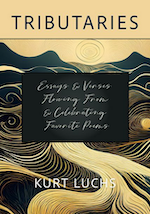 |
Clare MacQueen’s note:
Tributaries is a joy to read. Makes me cry and makes me laugh, which is the best kind of writing in my book. And such a gorgeous cover! I also especially appreciate that these tribute essays are “personal and idiosyncratic,” not “dry and dusty academic treatises” (as the author says in his introduction). In Tributaries you’ll find accessible and witty analysis and explication, not to mention remarkable poems written in response by someone who’s a “leprechaun of literature” himself. I heartily recommend this collection—this celebration of favorites—not only to readers who enjoy poetry and commentary, but also to writers who may be inspired to follow Kurt’s example.
H.D.
Hilda Doolittle (1886–1961) wrote under her initials in a career that stretched from 1909 to 1961. Although she is most well known for her lyric and epic poetry, H.D. also wrote novels, memoirs, short stories, essays, reviews, a children’s book, and translations. Quoted from H.D.’s biography at New Directions, which has published more than a dozen of her books:
https://www.ndbooks.com/author/hilda-doolittle-h.-d/
Kurt Luchs
won a 2022 Pushcart Prize, a 2021 James Tate Poetry Prize, the 2021 Eyelands Book Award for Short Stories, and the 2019 Atlanta Review International Poetry Contest. He is a Contributing Editor of Exacting Clam. His humor collection, It’s Funny Until Someone Loses an Eye (Then It’s Really Funny) (2017), and his poetry collections, Death Row Row Row Your Boat (2024) and Falling in the Direction of Up (2021), are published by Sagging Meniscus Press, along with his newest book, Tributaries: Essays & Verses Flowing From & Celebrating Favorite Poems (December 2025). He lives in Kalamazoo, Michigan.
Author’s website: https://kurtluchs.com/
More on the Web: By, About, and Beyond
⚡ Tributaries (a blend of literary criticism and original work that traces an author’s dialogue with the poems that inspire him) in Kirkus Reviews (4 November 2025)
⚡ The Incredibly Sexy World of Collector’s Plates by Kurt Luchs in Exacting Clam (No. 15, Winter 2024); in which we learn that he interviewed celebrities in his twenties, including Red Skelton (1981), the comedian who was also an artist who produced a thousand “corny clown paintings” and wrote thousands of songs (many of which were licensed by Muzak). Luchs also interviewed Shirley Temple Black in 1981, who was, as he was fascinated to learn, “this incredibly intelligent, well-read woman.”
⚡ Area Satire Rag Turns 35: The Real History of Fake News in which Luchs discusses the ten rules of writing for The Onion (which he did for several years) and the history of written humor in America; in Exacting Clam (No. 7, Winter 2022)
⚡ Contributor’s page for Kurt Luchs at Exacting Clam; scroll down for links to 22 of his works that are available online (Summer 2021 through Autum 2025). Others appear in printed issues of Exacting Clam, the quarterly magazine of arts and ideas published by Sagging Meniscus Press.
⚡ Some Cats, poem by Luchs in MacQueen’s Quinterly (Issue 27, March 2025); nominated for Best of the Net 2026
⚡ First One at the Diner, prose poem by Luchs in MacQ-27 (March 2025)
⚡ Crime Prevention in Wheaton, Illinois, poem by Luchs in MacQ-20 (September 2023)
⚡ Lives of the Gods, prose poem by Luchs in MacQ-7 (March 2021)
| Copyright © 2019-2026 by MacQueen’s Quinterly and by those whose works appear here. | |
| Logo and website designed and built by Clare MacQueen; copyrighted © 2019-2026. | |
|
Data collection, storage, assimilation, or interpretation of this publication, in whole or in part, for the purpose of AI training are expressly forbidden, no exceptions. |
At MacQ, we take your privacy seriously. We do not collect, sell, rent, or exchange your name and email address, or any other information about you, to third parties for marketing purposes. When you contact us, we will use your name and email address only in order to respond to your questions, comments, etc.