
|
||
 |
|

| Issue 35: | Nov. 2026 |
| Book Review: | 999 words |
By Ce Rosenow
A Beloved Fire Becomes the House
By Kat Lehmann
Red Moon Press, 2026
ISBN: 978-1-958408-92-6
6x9 inches // 144 pages
| In A Beloved Fire Becomes the House, Kat Lehmann addresses her experience of, and recovery from, trauma brought about by her mother’s schizophrenia and related behaviors. She simultaneously traces her establishment of a new relationship to her mother facilitated by a deepened understanding of both their experiences. Lehmann excels at the haibun form, deftly using it to chronologically follow her life with her mother from childhood on and concluding shortly after her mother’s death. The unflinching revelations of abuse, including | 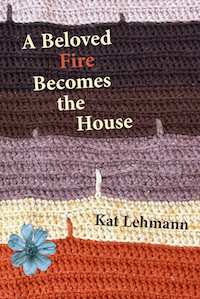 Red Moon Press July 2026 |
physical violence and deprivation, and the shockingly absent interventions by other adults, benefit from Lehmann’s skill as a poet. They elicit empathy, encourage understanding, and avoid melodrama and sensationalism. Rendering her own suffering and that of her mother in a thoughtful, nuanced way provides a healing path for Lehmann and for readers who may share versions of her experiences.
Poetry is recognized for its ability to heal. It helps people process experiences. It gives voice to those experiences through narratives that allow others to bear witness. Some of these narratives are inherited, some are from firsthand knowledge, and others are revisions of the first two types made possible by reflection. Crafting the poem also contributes to healing and wellness because it paradoxically immerses the writer in the material while creating distance from that material through decisions about form and technique. The high level of craft involved in Lehmann’s collection not only contributes to healing, as evidenced by the arc of the book and its conclusion, but models a way for others to pay close attention to formal decisions to help restore well-being.
The book’s title and subtitle signal that craft will be part of the healing. The title offers the first of many puzzles. How is a fire beloved? How does it become, not subsume, a house? By the end of the book, one realizes that diving directly into the pain of the past, grappling with the fire, is the only way Lehmann can create a stable home for herself and her family. She revisits painful memories, learns new information regarding her mother’s extreme version of schizophrenia, finds ways to recognize her mother’s love, and creates space for forgiveness. Defining the poems as metahaibun tells readers to expect self-reflexive poems and to pay close attention to the formal choices as they relate to the poems’ subjects and themes.
Lehmann engages a wide range of haibun styles. Some of her poems are more traditional—a prose paragraph followed by a haiku or a haiku followed by a prose paragraph—while many others demonstrate the varied approaches used today and enact the book’s project of inquiry, discovery, and meaning-making. For instance, some of them interlace multiple haiku and prose sections or use verse sequences. Others use free verse poetry followed by haiku or verse envelopes where the prose is surrounded by haiku. Some include multiple voices such as those of her mother or a hospital nurse.
One approach Lehmann frequently uses is braided haibun. In this version, the lines of the haiku are separated out at different points between the prose. On the first encounter, they appear as independent lines; however, rereading reveals the complete haiku that wasn’t initially visible. The “broken” haiku symbolizes the “fractured” reality Lehmann’s mother experiences and inflicts on Lehmann. Assembling the separate lines into a whole haiku represents the reconstructive work Lehmann undertakes to understand her past and her mother.
One of the most important instances of this approach is “Revelations.” The prose sections describe Lehmann searching through boxes of family materials for “anything worth saving,” and finding instead evidence of her mother’s state of mind. The first notebook has the “time and details of every person, vehicle, and sound outside her door. Alongside the lists are conversations with Cat Stevens. He offers to pay her trillions of dollars for her brooch.” Her mother thinks she is being watched by secret agents and mobsters. Other notebooks have Lehmann’s name written and rewritten as “the victim of unspeakable violations.” In this poem, the haiku is broken up beyond three single-line units to produce five lines. The result, “undertow / overtaking / mother writes / another rape / that never was,” foregrounds the mother’s fears and detachment from reality as well as Lehmann’s realization of her own presence in her mother’s delusions. The realization leads to a profound and empathetic understanding: “Then it hits me—how terrifying it must be, to be her.“ This poem is located almost directly in the center of the book, a pivotal point in the arc. The reader participates in the same reconstruction of reality by uniting the haiku lines and then arrives at the understanding experienced by Lehmann through the narrative prose. Both writer and reader move forward better prepared for the healing to come.
By the conclusion, Lehmann has faced and shared her experiences of abuse and disorder. She has grappled with confusion and conflicting narratives, and she continues to encounter revelations that move her toward healing. For instance, in “A Gray Field Filled with Flowers,” she describes how hospice called and she was able to arrive at her mother’s side and let her mother know she was there. It is at this moment her mother passes away. Lehmann states in the poem’s last lines, “I cannot think of a greater gift. She had waited for me.” The final poems depict Lehmann moving through the first months following her mother’s death. They are not easy, but she has come to a place of understanding and forgiveness, what she describes in the book’s final poem as a complicated peace.
A Beloved Fire Becomes the House is an exceptional example of contemporary English-language haibun. It adds to a growing body of haibun as confessional poetry and trauma poetry while also providing a map for others who, as the dedication states, “believed they lived a normal life until they shared their story,” and may want to write their way to wellness.
Ce Rosenow
is a writer, haiku poet and scholar, and educator who resides in Oregon. Her articles, essays, book reviews, and haiku and related forms are published widely in journals and anthologies in the USA and abroad. She is the author most recently of Lenard D. Moore and African American Haiku: Merging Traditions (Lexington Books, 2022).
She is co-author with Maurice Hamington of Care Ethics and Poetry (Palgrave/MacMillan, 2019), which addresses the relationship between poetry and feminist care ethics; one of four authors in The Color of Water edited by Carolyn Hall (Two Autumns Press, 2013); and one of eight authors in Beyond Within: A Collection of Rengay edited by Cherie Hunter Day (Sundog Press, 1997). Rosenow co-edited with Bob Arnold The Next One Thousand Years: The Selected Poems of Cid Corman (Longhouse Publishers, 2008).
The former president of the Haiku Society of America, Rosenow is Senior Editor for The Haiku Foundation’s JUXTA journal, Juxtapositions: Research and Scholarship in Haiku. She is also the former co-editor of Northwest Literary Forum and Portlandia Review of Books.
Author’s ePortfolio: https://rosenowce.wordpress.com/
| Copyright © 2019-2026 by MacQueen’s Quinterly and by those whose works appear here. | |
| Logo and website designed and built by Clare MacQueen; copyrighted © 2019-2026. | |
|
Data collection, storage, assimilation, or interpretation of this publication, in whole or in part, for the purpose of AI training are expressly forbidden, no exceptions. |
At MacQ, we take your privacy seriously. We do not collect, sell, rent, or exchange your name and email address, or any other information about you, to third parties for marketing purposes. When you contact us, we will use your name and email address only in order to respond to your questions, comments, etc.