
|
||
 |
|

| Issue 35: | Nov. 2026 |
| Book | Feature |
By Rebecca Weigold and
Lorette C. Luzajic
Ragged Psalms:
Two poems from the book, and
excerpts from the mutual interview
This collaborative collection of ekphrastic poems began as a dialogue between a pair of poets who had never met, but who had parallel experiences of losing their fathers and of going through breast cancer. They shared a love of art and poetry, and began exchanging their poems and writing together apart to works of art that spoke to each. Eventually, they met in person, and continued exchanging art and poems and writing that explored their experiences of mourning, illness, gratitude, friendship, and complicated faith. The result is Ragged Psalms.
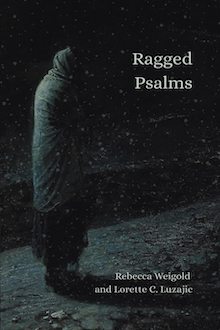 |
Ekphrastic poems Publisher: Cyberwit.net Release date: 24 June 2026 5.5 x 8.5 inches 87 pages Cover art: detail of painting by Nikolai Ge1 |
Two Poems from the Book
—After Over My Dead Body (1893)
by Ramon Casas i Carbó (Spain)2
A slurry of sun and street noise oozes under the windowpanes, gives voice to another city morning, burns off shadows from dull stained floors. A plump gray pigeon struts on a narrow sill. It’s going to be another sweltering day. Caruso croons “Ombra mai fu” somewhere between hisses of an exhausted record and through cracks in the walls. The smells of coffee and pollution compete with the clangor of pots, pans, and dishware.
None of it wakes her.
A buzzer at the door. Ladies downstairs cease their work. Caruso stops abruptly with a needle swipe across vinyl. Soft chatter echoes between city noise followed by footsteps ascending the stairs with daylight. She rises from her corner bed, quickly pins her hair back with hands dainty enough to reach inside and clean the gas lamps. She straightens her cotton gown, walks barefoot across creaky planks, leans against the door. Her heart is open and vast as the many pain-filled chambers of her small universe. He stands framed in bright light with an inviting hand. She puts her hand in his.
None of it wakes her.
—Rebecca Weigold
—After Pietà (1499) by Michelangelo (Italy)3
You could not imagine the blood. Rivers running from the broken feet of our Saviour. You could not imagine the thirst, the mocking sting of that vinegar sponge against dry lips desperate for water. You could not imagine the cruel heat of that day. How the great span of black feathers darkened the hillside, as the circling griffon vultures taunted the men who become their carrion. Even over the thundering of the temple tearing and the tumbling earthquake of rocks breaking open the world, the sound of his mother weeping.
—Lorette C. Luzajic
MacQ Footnotes:
Links above and below were confirmed in November 2026. Poems are curated here with permissions from the poets. The following artworks are reproduced from the public domain.
- Conscience, Judas (oil on canvas, 1891) by Russian painter Nikolai Ge (1831–1894) is held by The State Tretyakov Gallery in Moscow, Russia. For details about the painting, see the summary posted by Inspiraggio to Facebook (2 October 2026). Image below is from Wikimedia Commons:
https://commons.wikimedia.org/wiki/File:Nikolaj_Nikolajewitsch_Ge_002.jpg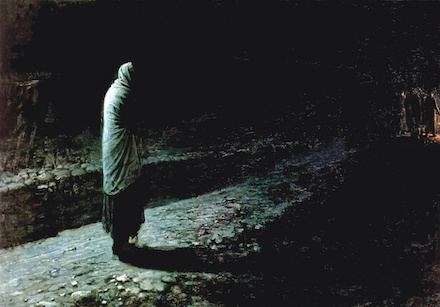
- Over My Dead Body (Sobre mi cadáver) (oil on canvas, 1893) by Catalan painter Ramon Casas i Carbó (1866–1932) is held in the National Art Museum of Catalonia in Barcelona. Image below is from Wikimedia Commons:
https://commons.wikimedia.org/wiki/File:Ramon_Casas_-_Over_My_Dead_Body_-_Google_Art_Project.jpg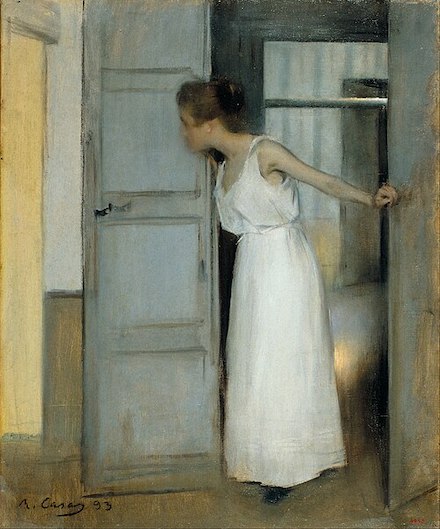
- Pietà (marble sculpture, circa 1499) by Italian artist Michelangelo (1475–1564) is held in Saint Peter’s Basilica in Vatican City. Image below is from Wikimedia Commons:
https://commons.wikimedia.org/wiki/File:Michelangelo%27s_Pieta_5450_cropncleaned_edit.jpg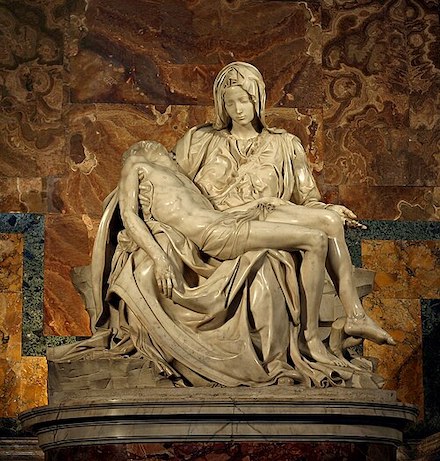
Excerpts from the Mutual Interview
[Each poet asked the other seven questions, and two from each follow.]
[Q&A 1-2]
Lorette C. Luzajic: Tell us about your relationship to visual art. How did you become interested in ekphrasis? How does the art feed your poems and your writing practice in general?
Rebecca Weigold: My introduction to The Ekphrastic Review several years ago was my initiation into the wonderful world of ekphrasis. I found the art to be compelling and the writing, magical. Art soon became the primary inspiration for my writing, as well. As someone who struggles with mental health, poetry based on art is as therapeutic for me as gardening may be to someone else. When I consider a painting, it is as though I have an inner dialogue with the artist as therapist, challenging me to examine my thought life from other perspectives. A centuries-old painting can give new context to modern-day experience. I almost always find a thread of commonality between the artist or the art and me.
Lorette C. Luzajic: Many of your poems are deeply imagined, taking the reader into a life outside of yours and theirs. Tell us about what the process is like for you when you take on another history or persona.
Rebecca Weigold: At times, the process of writing an ekphrastic poem is like drawing from my past in theatre. I sometimes think of the artist or subject in a painting as a character on the literary stage.
For example, the subject of my poem, “Aria for Aloise,” is the artist, Aloise Corbaz. Aloise was schizophrenic and lived in an asylum. Her dream of being an opera singer inspired my poem based on her colourful drawing, Star of the Paris Opera. As someone familiar with mental illness, I channeled Aloise through that perspective. Having experienced a stay in a psychiatric institution, I understand how she may have yearned for the power to change her destiny from that of grim isolation to something exotic and grand. Artists like Aloise, especially those oppressed or subject to mental illness, deserve their art to be seen and their stories heard. I hope that through this poem in some small sense, I got to help Aloise be memorialized as the opera star she always wanted to be.
[...]
[Q&A 9]
Rebecca Weigold: Which of your poems in this book holds the most personal meaning to you and why?
Lorette C. Luzajic: “Mrs. Luzajic as Hebe” is a kind of “life flashing before your eyes” poem, reflecting on mortality, the experience of fighting breast cancer, and a lifetime of memory fragments, a poem for a poet friend who was fighting cancer, too. This is triply poignant because it is in a book written with you, who went through this battle right before it happened to me. Thinking about how cancer is everywhere, in one’s self and in one’s closest friends, is really overwhelming and frightening. But the poem is about the important things I learned: friendship is everything, and comes in unusual, unexpected ways and different forms. It’s a poem of gratitude to have friends who carry me, and for being able to see that every day is a gift.
[...]
[Q&A 13]
Rebecca Weigold: In your poem, “Walking After Midnight,” you describe a scene: “Oh, there were times I felt as if I had no eyes at all, only heart, sleepwalking, feeling my way from one precipice to another.” Have you ever felt this way about the writing process?
Lorette C. Luzajic: I think the fact that I feel too much is both the strength and weakness of my writing. Many writers are highly sensitive, oversensitive one might say unkindly, and from that very quality are driven to process and make sense of things through writing. Feeling things so intensely gives a writer the ability to notice and the drive to give a narrative to the drama or assign some kind of meaning to everything that happens. I don’t shy away from any emotion or experience, whether ebullient and joyful, or painful; I cop to my darkest fantasies and most embarrassing excesses, and I think that makes for rich and authentic poems that people can feel and relate to. It also gives me the tendency towards over-sharing, over dramatization, and heavy-handed sentimentality or related blunders. So yes, in a way, I feel this way about the writing process all the time! I hope what I have learned with time and experience is a little context, and to temper the intensity of the heart with complexity, motivation, contrast, and reason. I fear that’s not always the case, but I am a work in progress, like we all are.
—Excerpts from “Ragged Psalms: Mutual Interview, Rebecca Weigold and Lorette C. Luzajic” are curated here with permissions from the poets, and were first published in The Ekphrastic Review (25 July 2026):
https://www.ekphrastic.net/the-ekphrastic-review/ragged-psalms-mutual-interview-rebecca-weigold-and-lorette-c-luzajic
Rebecca Weigold
studied Theatre and English, specializing in poetry, at Northern Kentucky University. Her poems have appeared in a variety of print and online publications, including The Ekphrastic Review (multiple poems + interviews); Floating Acorn Review (Issue 4, October 2025); The Memory Palace: An Ekphrastic Anthology (Ekphrastic Editions, 2024); Rat’s Ass Review (Fall-Winter 2025); and Tipton Poetry Journal (Summer 2016), among others.
Rebecca’s poetry has been nominated multiple times for the Pushcart Prize, and one of her poems has been translated into Arabic. Additionally, she is proud to have participated in the renowned Uptown Poetry Slam on multiple occasions, hosted by Marc Smith at the historic Green Mill in Chicago. In 1987, she founded The Cincinnati Poets’ Collective, an annual poetry journal featuring the work of regional, national, and international writers, which she published for a decade.
Lorette C. Luzajic
writes, edits, publishes, and teaches prose poetry and small fictions, usually ekphrastic. Her own fiction and prose poems have appeared in Bending Genres, The Citron Review, The Disappointed Housewife, Flash Boulevard, Ghost Parachute, MacQueen’s Quinterly, New Flash Fiction Review, Trampset, Unbroken, and beyond. Her works have been nominated for Best of the Net, the Pushcart Prize, Best Microfiction, and Best Small Fictions. Two of her flashes were chosen for Best Small Fictions anthologies.
She’s also the author of five collections of small fictions and/or prose poems: Disgust; The Rope Artist; The Neon Rosary; Pretty Time Machine; and Winter in June.
Lorette is the founding editor of The Mackinaw, a journal of prose poetry, which debuted on 15 January 2024. She is also the founding editor of The Ekphrastic Review, the flagship journal established in 2015 and devoted to literature inspired by visual art. The Ekphrastic Review’s first print anthology, co-edited with Clare MacQueen, was released in March 2024: The Memory Palace.
In addition, Lorette’s a teaching artist, and an award-winning neoexpressionist artist who works with collage and mixed media to create urban, abstract, pop, and surreal works. She has collectors in forty countries so far. She is also passionately curious about art history, folk horror, ancient civilizations, artisan and tribal jewelry, and culinary lore, to name a few.
Visit her at: www.mixedupmedia.ca
More on the Web: By, About, and Beyond
⚡ Dispatch from a Yellow Car: Snippets from an Ongoing Conversation with Lorette C. Luzajic by Brent Terry in The Fortnightly Review (26 August 2026). Includes Lorette’s poem “Mrs. Luzajic as Hebe” from the book Ragged Psalms (as well as Brent Terry’s poem “Prom” and Lorette’s collage The Yellow Car 2018, which inspired his poem).
| Copyright © 2019-2026 by MacQueen’s Quinterly and by those whose works appear here. | |
| Logo and website designed and built by Clare MacQueen; copyrighted © 2019-2026. | |
|
Data collection, storage, assimilation, or interpretation of this publication, in whole or in part, for the purpose of AI training are expressly forbidden, no exceptions. |
At MacQ, we take your privacy seriously. We do not collect, sell, rent, or exchange your name and email address, or any other information about you, to third parties for marketing purposes. When you contact us, we will use your name and email address only in order to respond to your questions, comments, etc.