
|
||
 |
|

| Issue 31: | Jan. 2026 |
| Book Review: | 640 words [R] |
By Marianne Paul
Crazy Bitches, selected haibun
|
By Roberta Beary Publisher: MacQ Winston-Salem, NC, USA Release date: 8 March 2025 ISBN: 979-8-3305-6606-8 6x9 inches // 128 pages |
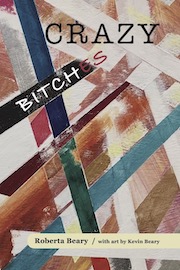 MacQ (March 2025) |
If you’re looking for pretty prose or idyllic narrative, Crazy Bitches by Roberta Beary isn’t for you. There’s nothing pretty or idyllic about it. I say that with immense respect for Roberta Beary’s poetry and storytelling. The selected haibun are both startling and beautifully written, and occasionally darkly comic. There is no room in the reading for complacency.
Beary is a master of her craft. Don’t just take my word for it. There’s a slew of previous publications that make my point.
Beary’s work has appeared in a myriad of haiku and other literary publications. She is the author of several books, and has twice won The Snapshot Press Book Award, in 2005 for The Unworn Necklace and again in 2019 for Carousel.
Beary’s collection brings together 80 selected haibun written and published from 2004-2024. For those of you who are new to Japanese-styled literary forms, haibun combines prose and haiku into a single piece of writing. If you want to learn more about the form, your best bet is it go to the source herself. Beary coauthored with Lew Watts and Richard Youmans, Haibun: A Writer’s Guide (Ad Hoc Fiction, 2023).
In Crazy Bitches (doesn’t that title get your attention!), Beary cracks open taboos that are hidden in polite society, whether by societal and cultural prohibitions, family suppression or denial, or the inner depths of one’s injury and pain, the misplaced shame and gaslighting that shifts fault to the victim.
Beary does it without excesses—whether of emotional or intellectual discourse and arguments or opinions. Her strength as a writer is that she lets the acts speak for themselves, the narrative speak for itself.
As readers, we hold our breath—oh no, that’s not where this is going, where the narrative is taking us, is it? ... And often it is, our suspicions coming true, a child led by a priest into his private spaces, an adult climbing into a young girl’s bed, breaches of trust ...
cold front—
my exposed parts
under the quilt
Other times, Beary traverses the difficulties of everyday life—and death—families, relationships, illnesses:
chemo chair
the day lily’s
open eyes


asylum moon
the twisted trail
of chromosomes
And then this monoku, beautifully written, stark and devastating:
crushed spider in my open palm the future tense
Beary makes stylistic choices that cycle through the haibun, both individually and through the collection as a whole. They add a stripped-down urgency to the text, a beautiful improper-ness to the syntax, disruptions to how we expect text to proceed. Each of these devices has the effect of making us pay attention, as readers, almost like a kind of signpost, a literary defiance of convention—this isn’t business as usual, so don’t expect it.
Beary skilfully utilises sentence fragments piled up one behind another, or run-on sentences leaving no full-stops, no space for breathing. And my favourite, a repetition of an introductory clause or word to start each sentence, taking us into a loop where events in the sequence are interconnected, and the narrative moves into the rhythm and feel of a prose poem.
Art, in whatever form it takes—dance, theatre, visual sculpture or paintings, music, prose, poetry, and yes, even haiku—pushes us to look at life in a way that is not always comfortable. Art reveals things to us, evokes a response, often emotional. We feel.
Reading Crazy Bitches, you can’t help but feel.
abortion day
a shadow flutters
the fish tank
“At the end of the day,” Beary tells us in Haibun: A Writer’s Guide, “I write haibun for the people who view themselves as unseen and unheard. The person whose hurt is too big to carry. Or who was told no one will believe you. I want that person to know I see you; I hear you. You are not alone.”*
—This review was first published in the print journal Haiku Canada Review (Vol. 19, No.2, October 2025), and appears here with author’s permission.
*Publisher’s Note:
Haibun: A Writer’s Guide was published in June 2023 by Ad Hoc Fiction. See also Ce Rosenow’s review of the Guide in MacQueen’s Quinterly (Issue 24, August 2024).
Marianne Paul
is a Canadian poet, novelist, artist, bookbinder, and the founder of Paper Heron Press, a micro-publishing house that creates handcrafted and bespoke books of short-form poetry.
In recent years, she has worked primarily with haiku and haiga, both digitally and manually, often incorporating mixed media such as collage. Human/Kind Press published Paul’s chapbook Body Weight: A Collection of Haiku and Art, which won the Haiku Canada Marianne Bluger Chapbook Award in 2019.
Her haiku and art have also been recognized through first-place standings in the Jane Reichhold Memorial Haiga Competition, the Vancouver Cherry Blossom Haiku Festival, and the Shambhala Times Midwinter Haiku contest, and as a finalist in the Trailblazers Contest.
To learn more about the artist and her work, please visit her websites:
https://www.mariannepaul.com/ and
https://www.literarykayak.com/
More on the Web: By, About, and Beyond
⚡ New to Haiku: Advice for Beginners—Marianne Paul by Julie Bloss Kelsey at The Haiku Foundation (2 June 2024)
| Copyright © 2019-2026 by MacQueen’s Quinterly and by those whose works appear here. | |
| Logo and website designed and built by Clare MacQueen; copyrighted © 2019-2026. | |
|
Data collection, storage, assimilation, or interpretation of this publication, in whole or in part, for the purpose of AI training are expressly forbidden, no exceptions. |
At MacQ, we take your privacy seriously. We do not collect, sell, rent, or exchange your name and email address, or any other information about you, to third parties for marketing purposes. When you contact us, we will use your name and email address only in order to respond to your questions, comments, etc.